
Top 5 Pen Assembly Machines Ranked by Capacity and Build Quality
Quick answer: In Paifeite Automation's documented pen assembly machine lineup, the 357A Pen Production Line Equipment holds the highest single rated capacity at 140 pcs/min. It is followed by the 395A1 Ballpoint Pen Assembly Machine and the 372A Pen Refill Assembly Machine, both rated at 120–140 pcs/min, then the 415A Non-standard Pen Assembly Machine at 120–140 pcs/min, and the 399A2 Gel Pen Assembly Machine at 120–130 pcs/min. Across the top five, the construction pattern stays consistent: painted carbon steel or aluminium profile frames, 304 stainless steel, 45# steel or 6061 aluminium in load-bearing and contact areas, and engineering nylon or engineering plastics in guide and wear components.
This ranking is written for importers, OEM and ODM pen manufacturers, stationery factory engineers and procurement managers who need to compare machine specifications rather than marketing claims. Every capacity figure, dimension, material list and certificate number below is drawn from published model documentation or from cited third-party sources, and each model is ranked on measurable data only.
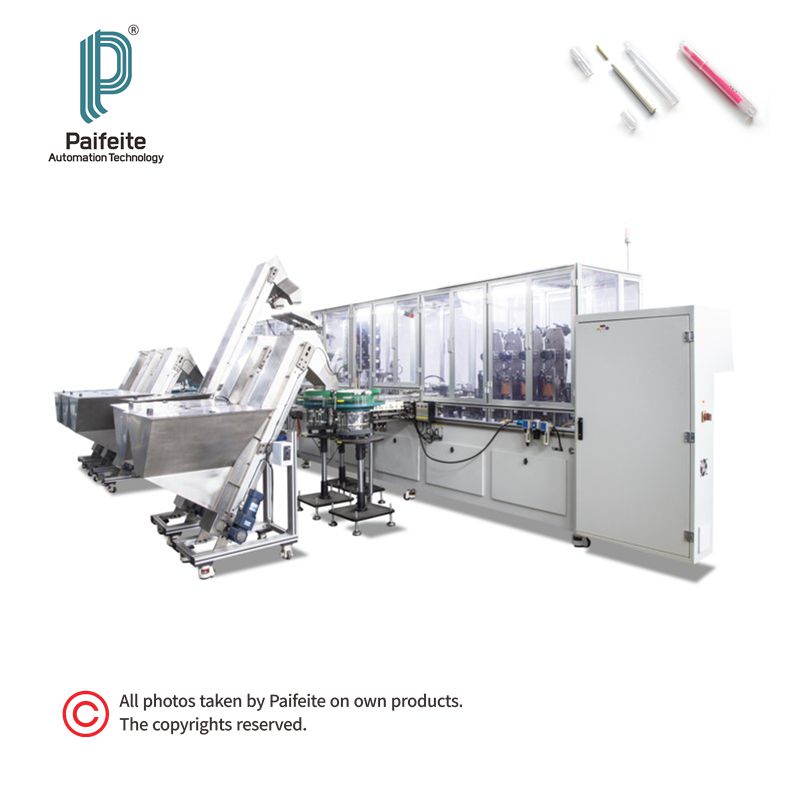
357A Pen Production Line Equipment, the highest rated capacity model in this ranking: 140 pcs/min with 4-output chain carry assembly.
Why Capacity and Build Quality Have to Be Ranked Together
A rated capacity such as 120–140 pcs/min is a band, not a constant. It reflects the designed cycle rate combined with the number of assembly outputs per cycle — four outputs per time on a chain-carry transfer for most models in this lineup, and two outputs per time on the slower models that handle larger or more delicate components. Buyers who rank machines on the top of the band alone often discover the gap later, when the line is expected to hold that figure across three shifts.
Build quality is what keeps the band achievable. Frame material determines how the machine behaves under vibration at rated speed. Contact and wear materials determine how long assembly geometry stays inside tolerance. The transfer type determines how parts are located and held between stations. In this lineup, three construction patterns appear repeatedly:
- Aluminium profile frame with 304 stainless steel, engineering nylon and painted carbon steel in functional areas — used on the 395A1 Ballpoint Pen Assembly Machine, the 372A Pen Refill Assembly Machine, the 386A Whiteboard Marker Assembly Machine, the 417A1 Marker Pen Assembly Machine and the 363A Insulin Pen Assembly Machine.
- Carbon steel, aluminium alloy, stainless steel and engineering plastics — used on the 357A Pen Production Line Equipment, the 415A Non-standard Pen Assembly Machine and the 359A Pen Making Assembly Equipment. The 396A1 Automatic Pen Assembly Machine uses the same frame family with alloy steel, engineering plastic and rubber in key parts.
- 45# steel, 6061 aluminium and stainless steel — used on the 399A2 Gel Pen Assembly Machine.
The third variable is compliance. A machine that leads on throughput but has no applicable attestation for the destination market cannot be deployed in the EU, regardless of how well it performs on a test bench. That is why certification coverage is treated below as a constraint layer rather than an afterthought.
Where the Demand for Faster Pen Assembly Is Coming From
The global automated assembly machine market was valued at USD 2,624.73 million in 2023 and is projected to reach USD 4,098.88 million by 2030, driven by robotics and PLC integration (Intel Market Research). Pen assembly machines sit inside that curve: they combine mechanical feeding, PLC control, pneumatic actuation and inline inspection into a single integrated cell.
On the stationery side, China's export value of ballpoint pens grew to USD 1.121 billion in 2024, with total pen exports reaching USD 2.65 billion (OEC). That scale indicates a mature component and machinery supply chain rather than scattered production, which in turn means machine buyers can compare documented specifications instead of accepting generic capability claims.
On the medical side, the global injection pen market, including insulin pens and disposable pen injectors, reached USD 47.0 billion in 2024 and is growing at a CAGR of 7.9% through 2030 (MarketsandMarkets). Disposable pen injectors held an 87.9% market share in 2025 (Fortune Business Insights), a share that places direct pressure on assembly throughput and dimensional consistency. ISO 11608-1:2022 defines the primary design and verification requirements for needle-based injection systems, including pen injectors (ISO).
The supplier landscape reflects this split. For medical pen injectors, Mikron Automation publishes assembly expertise covering pre-assembly and final assembly of pen injectors (Mikron Group). For stationery pen production, specialised builders such as Suzhou Paifeite Automation Technology Co., Ltd., founded in 2004 and operating a 1,750 m² facility in Suzhou, China, supply dedicated pen assembly machines. This article ranks machine models and their specifications, not companies.
How This Ranking Was Built
Five criteria were applied, in this order of weight:
- Rated capacity band (pcs/min). The published figure for each model, taken as the primary ranking input.
- Assembly mode. Outputs per cycle, carry system and transfer orientation, which together determine how the rated capacity is physically achieved.
- Frame and build materials. The materials used in the frame, load-bearing structures and contact areas, taken from the published material lists.
- Documented certification coverage. Whether the model appears as a related product on an issued UDEM attestation, and whether a QMS certificate applies.
- Footprint (L × W × H). A layout constraint that determines how much floor area a model consumes and whether it fits an existing line.
Price is deliberately excluded from the ranking criteria. Cost is configuration-specific and depends on capacity band, build materials, certification scope and the depth of customization, so a fixed price ranking would not be reliable for procurement decisions.
The Top 5 Pen Assembly Machines, Ranked
RANK 1357A Pen Production Line Equipment — 140 pcs/min
The 357A carries the highest single rated capacity in the documented lineup. Its rated output is 140 pcs/min, achieved with four outputs per time on a chain carry system. The frame and structural materials are carbon steel, aluminium alloy, stainless steel and engineering plastics, a combination that supports a long, multi-station transfer line rather than a single compact station. The machine measures L6200 × W1800 × H2000 mm and is positioned for stationery and office supplies manufacturing, custom advertising and gift pen production, and medical, industrial and cosmetic marking pen production.
357A specification summary
- Rated capacity: 140 pcs/min
- Assembly mode: 4 outputs per time, chain carry
- Dimensions: L6200 × W1800 × H2000 mm
- Materials: carbon steel, aluminium alloy, stainless steel, engineering plastics
- Typical industries: stationery and office supplies; custom advertising and gift pens; medical, industrial and cosmetic marking pens
Trade-off to note: the 357A is a line-level asset. It rewards buyers who need throughput at production-line scale, and it consumes more floor area than a single-task assembly station. It is also not listed among the related products on the UDEM attestations held in the documentation set, so EU-bound projects should confirm which attestation applies to the final line configuration before purchase.
RANK 2395A1 Ballpoint Pen Assembly Machine — 120–140 pcs/min
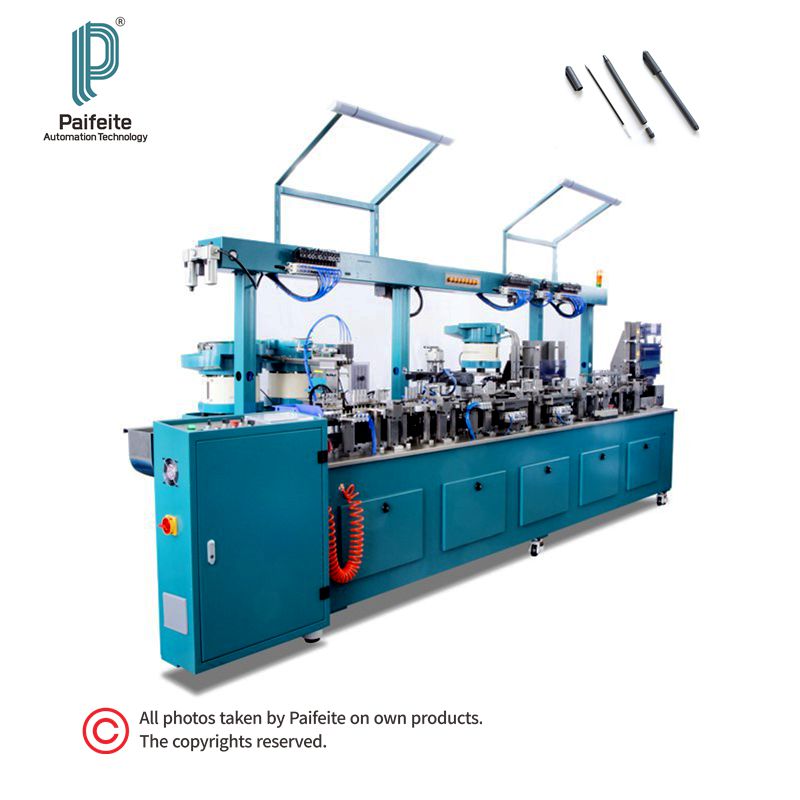
395A1 Ballpoint Pen Assembly Machine: 4-up chain carry horizontal assembly, rated 120–140 pcs/min.
The 395A1 sits at the top of the 120–140 pcs/min band with a shorter frame than the higher-volume positioning of the 357A. Its assembly mode is 4 up, chain carry, horizontal type, and it measures L4800 × W1700 × H2000 mm. The published material list is aluminium profile, 304 stainless steel, engineering nylon and painted carbon steel — a build that places stainless steel and engineering nylon in the areas where wear and part contact matter most. It is applied to the automatic assembly of both ballpoint pens and gel pens.
What puts the 395A1 in second place rather than lower is its documented compliance footprint. The model is covered by an Attestation Certificate of Machinery and Low Voltage Directives issued by UDEM under number M.2023.201.N4908, based on the standards EN ISO 12100:2010 and EN 60204-1:2006+A1:2009+AC:2010. It also appears among the related products of attestation M.2022.206.C79855 and attestation M.2023.206.C91417, and it is included under QMS certification 69025Q0048R1S, issued under GB/T 19001-2016/ISO 9001:2015 and recognised in 178 countries and regions worldwide. For a buyer who needs both throughput and a clean compliance file, that combination is the strongest in the 120–140 pcs/min group.
Trade-off to note: the 395A1 assembles complete ballpoint and gel pens. Refill-only production is a different scope and belongs to the 372A below.
RANK 3372A Pen Refill Assembly Machine — 120–140 pcs/min
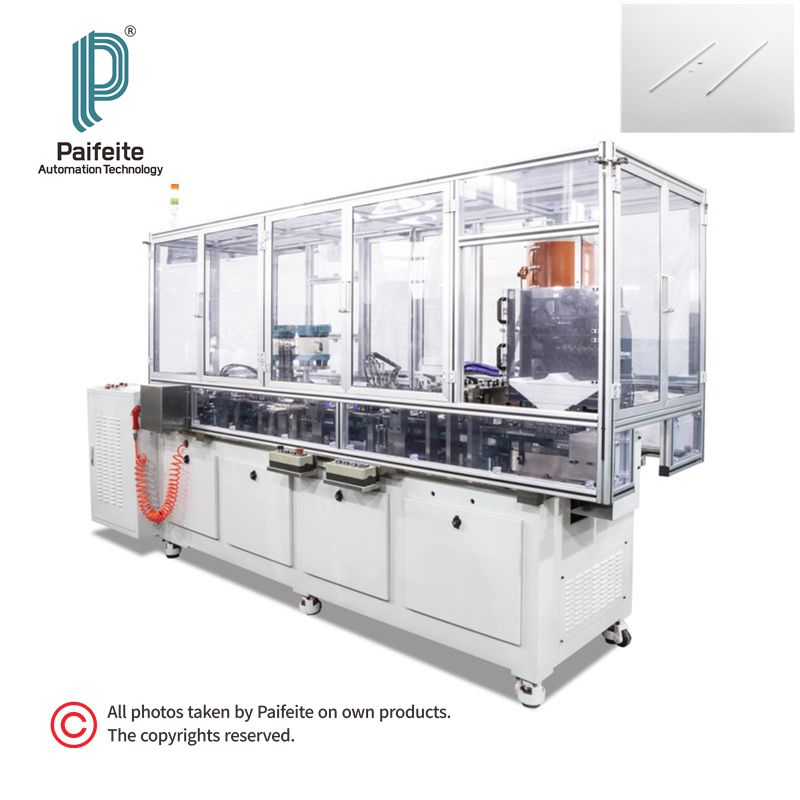
372A Pen Refill Assembly Machine: 120–140 pcs/min in a L3500 × W1500 × H2000 mm frame, the most compact footprint among the high-output models.
Measured as throughput per square metre of floor space, the 372A is the most efficient model in this ranking. It is rated at 120–140 pcs/min with four outputs per time on chain carry, but its frame is only L3500 × W1500 × H2000 mm — roughly 5.25 m² of footprint. Materials are aluminium profile, 304 stainless steel, engineering nylon and painted carbon steel, the same wear-resistant pattern used on the 395A1. The machine is applied to the automatic assembly of pen refills across stationery production.
Its CE certification is explicit and current: the Pen Refill Assembly Machine is certified under number M.2023.20L.N4924, issued by UDEM, valid from June 6, 2023 to June 5, 2028, for permanent use throughout the EU, Türkiye and all of Europe. The certificate covers the Machinery Directive, Low Voltage Directive and EMC Directive, with standards EN ISO 12100:2010 and EN 60204-1:2006+A1:2009+AC:2010. The model is also listed among the related products of attestation M.2023.206.C91417 and falls under QMS certification 69025Q0048R1S.
Trade-off to note: the 372A assembles refills, which are an upstream component rather than a finished pen. Its third-place position reflects that scope difference: for a factory producing complete pens, the 372A is a supporting asset feeding a complete-pen machine rather than the primary assembly cell.
RANK 4415A Non-standard Pen Assembly Machine — 120–140 pcs/min
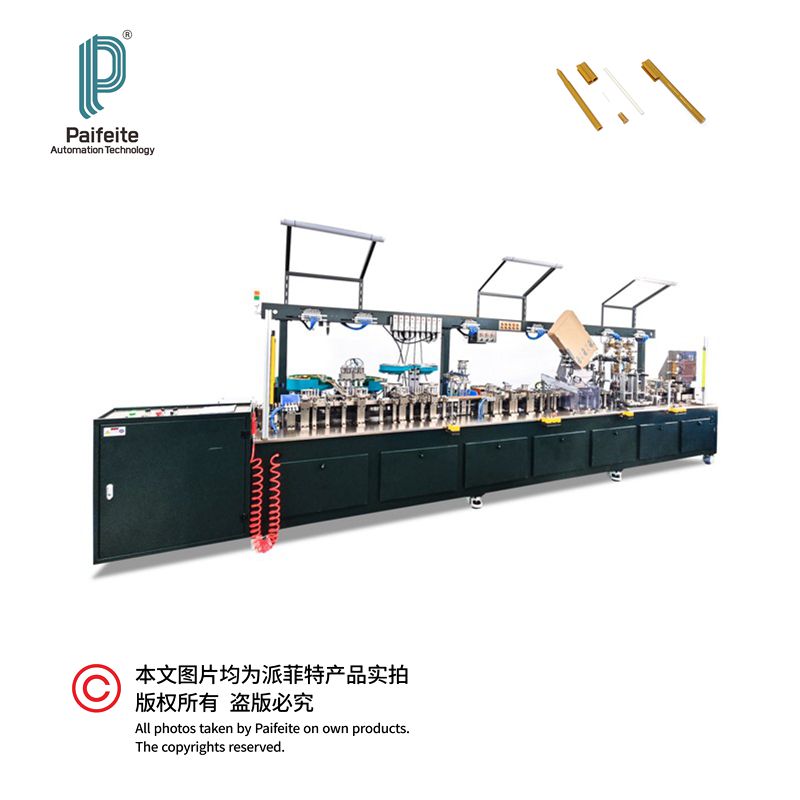
415A Non-standard Pen Assembly Machine: 4 up chain carry horizontal assembly covering gel pens, ballpoint pens and fountain pens.
The 415A matches the leading capacity band at 120–140 pcs/min with four outputs per time, chain carry and a horizontal layout. Its build uses carbon steel, aluminium alloy, stainless steel and engineering plastics across a L6800 × W1800 × H2000 mm frame. Where it stands apart is product breadth: it is applied to mass production and automatic assembly of gel pens, ballpoint pens, fountain pens and other writing instruments, which makes it the widest-scope standard machine in the top five.
Trade-off to note: the 415A is non-standard by definition, and it consumes the largest floor area in this ranking at roughly 12.24 m². Because the configuration is engineered per project, buyers heading to the EU should confirm which attestation applies to the final configuration, and should treat the machine layout dimensions as a project input rather than a fixed constraint.
RANK 5399A2 Gel Pen Assembly Machine — 120–130 pcs/min
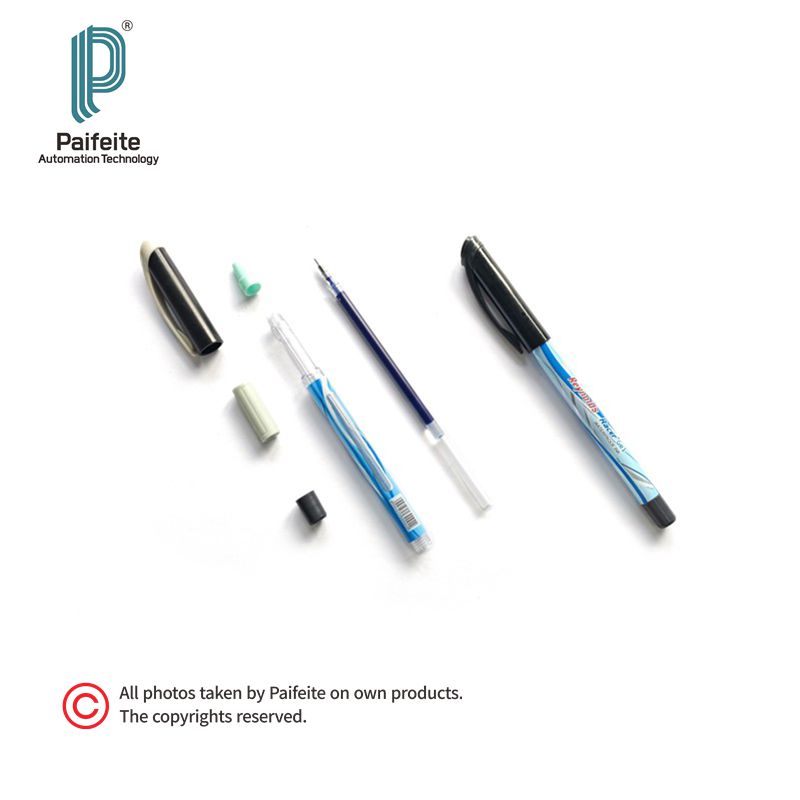
Component set handled by the 399A2 Gel Pen Assembly Machine, which runs a two-type universal assembly mode at 120–130 pcs/min.
The 399A2 is the only model in this lineup that publishes a two-type universal assembly mode, meaning it is designed to handle two pen types on one machine rather than being dedicated to a single product family. Rated capacity is 120–130 pcs/min at 4 up, chain carry, horizontal type, on a L7000 × W1500 × H2300 mm frame built from 45# steel, 6061 aluminium and stainless steel. It serves stationery manufacturing, pen making and office supplies production.
Its certification profile is the deepest in the ranking. The model holds a Machinery Directive Attestation of Conformity issued by UDEM under number M.2023.206.C91417, valid from October 13, 2023 to October 12, 2028, applying the standards EN ISO 12100:2010 and EN 60204-1:2018. It also appears among the related products of attestations M.2023.201.N4908 and M.2022.206.C79855, and it is covered by QMS certification 69025Q0048R1S under GB/T 19001-2016/ISO 9001:2015, recognised in 178 countries and regions worldwide.
Trade-off to note: the top of the rated band is 130 pcs/min rather than 140 pcs/min, and the frame is the longest and tallest in the ranking. The 399A2 is the right choice when compliance depth and two-type flexibility matter more than peak output.
Models Evaluated but Not Ranked in the Top Five
Several machines in the same portfolio fall outside the top five on the capacity and build criteria used here. This is a scope outcome, not a quality judgement:
- 396A1 Automatic Pen Assembly Machine — 120–140 pcs/min, 4 up chain carry horizontal, L4800 × W1700 × H2000 mm, with a carbon steel, aluminium alloy and stainless steel frame plus alloy steel, engineering plastic and rubber key parts. It overlaps the 395A1 on capacity and dimensions, and is positioned as a general automatic assembly platform.
- 417A1 Marker Pen Assembly Machine — 100–120 pcs/min, 4 up chain carry horizontal, L6900 × W2400 × H2000 mm, for marker pens, whiteboard pens and highlighters.
- 386A Whiteboard Marker Assembly Machine — 50–70 pcs/min, 2 up chain carry horizontal, L6800 × W1600 × H2200 mm, for whiteboard markers, dry erase pens and marker pens.
- 363A Insulin Pen Assembly Machine — 50–60 pcs/min, 2 outputs per time chain carry, L3100 × W1400 × H1800 mm, built with aluminium profile, medical-grade 304 stainless steel, engineering nylon and painted carbon steel for automatic assembly of insulin pens and medical injection pens.
- 359A Pen Making Assembly Equipment — 50–60 pcs/min, 2 outputs per time on a high-precision link conveyor, L4200 × W2500 × H1900 mm.
The lower rated capacities on the medical and marker models reflect a different engineering trade-off — larger component size and higher cleanliness or precision requirements — rather than lighter construction. The 363A, for example, is the only model in the portfolio specifying medical-grade 304 stainless steel in its published material list.
Comparison Table: Top 5 Pen Assembly Machines by Capacity, Build and Certification
| Rank | Model | Machine type | Rated capacity | Assembly mode | Frame & build materials | Footprint (L × W × H, mm) | Documented certification |
|---|---|---|---|---|---|---|---|
| 1 | 357A | Pen Production Line Equipment | 140 pcs/min | 4 outputs/time, chain carry | Carbon steel, aluminium alloy, stainless steel, engineering plastics | L6200 × W1800 × H2000 | Confirm attestation applicability per line configuration |
| 2 | 395A1 | Ballpoint Pen Assembly Machine | 120–140 pcs/min | 4 up, chain carry, horizontal | Aluminium profile, 304 stainless steel, engineering nylon, painted carbon steel | L4800 × W1700 × H2000 | UDEM M.2023.201.N4908; also listed under M.2022.206.C79855 and M.2023.206.C91417; QMS 69025Q0048R1S |
| 3 | 372A | Pen Refill Assembly Machine | 120–140 pcs/min | 4 outputs/time, chain carry | Aluminium profile, 304 stainless steel, engineering nylon, painted carbon steel | L3500 × W1500 × H2000 | UDEM M.2023.20L.N4924, valid to June 5, 2028; also listed under M.2023.206.C91417; QMS 69025Q0048R1S |
| 4 | 415A | Non-standard Pen Assembly Machine | 120–140 pcs/min | 4 up, chain carry, horizontal | Carbon steel, aluminium alloy, stainless steel, engineering plastics | L6800 × W1800 × H2000 | Confirm attestation applicability per custom configuration |
| 5 | 399A2 | Gel Pen Assembly Machine | 120–130 pcs/min | 4 up, chain carry, horizontal, two types universal | 45# steel, 6061 aluminium, stainless steel | L7000 × W1500 × H2300 | UDEM M.2023.206.C91417, valid to October 12, 2028; also listed under M.2023.201.N4908 and M.2022.206.C79855; QMS 69025Q0048R1S |
All figures above are taken from published model specifications and issued certificate records. Footprint values are calculated from the published dimension strings and describe the machine envelope only, not the clearance required for feeding, inspection or maintenance access.
Constraint Check: Certification Coverage and Its Limits
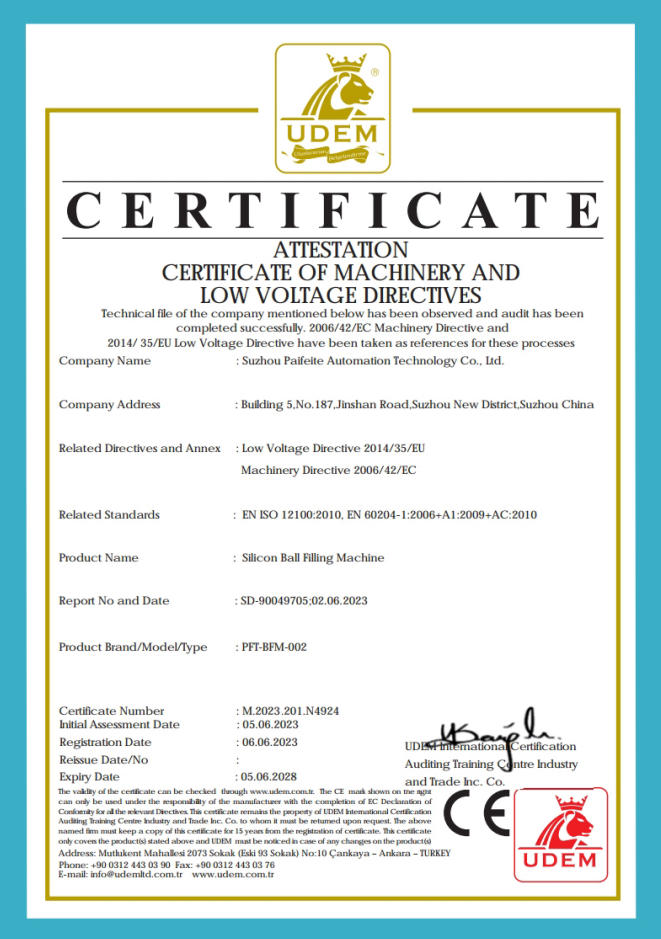
UDEM attestation M.2023.20L.N4924 covers the 372A Pen Refill Assembly Machine and related pen assembly models for permanent use in the EU, Türkiye and all of Europe.
For EU-bound procurement, the certificate file is as much a specification as the capacity rating. The documentation set for this portfolio contains four UDEM attestations plus one QMS certificate, issued between 2022 and 2025:
- M.2023.20L.N4924 — covers the Machinery, Low Voltage and EMC directives; valid June 6, 2023 to June 5, 2028; standards EN ISO 12100:2010 and EN 60204-1:2006+A1:2009+AC:2010; related products include the 372A Pen Refill Assembly Machine, the 395A1 Ballpoint Pen Assembly Machine and the 399A2 Gel Pen Assembly Machine.
- M.2023.201.N4908 — covers the Machinery and Low Voltage directives; standards EN ISO 12100:2010 and EN 60204-1:2006+A1:2009+AC:2010; related products include the 395A1, the 399A2, the 417A1, the 386A and the 363A.
- M.2022.206.C79855 — covers the Machinery, Low Voltage and EMC directives; issued December 1, 2022, valid to November 30, 2027; standards EN ISO 12100:2010 and EN 60204-1:2018; related products include the 363A, the 386A, the 417A1, the 395A1 and the 399A2.
- M.2023.206.C91417 — Machinery Directive Attestation of Conformity; issued October 13, 2023, valid to October 12, 2028; standards EN ISO 12100:2010 and EN 60204-1:2018; related products include the 399A2, the 363A, the 372A, the 395A1, the 386A and the 417A1.
- QMS 69025Q0048R1S — issued by TANZN under GB/T 19001-2016/ISO 9001:2015, valid March 15, 2025 to March 14, 2028, with a scope recognised in 178 countries and regions worldwide.
The constraint is straightforward. The 395A1 and the 399A2 appear on three UDEM attestations plus the QMS certificate. The 372A appears on one model-specific CE certificate plus one further attestation and the QMS certificate. The 357A and the 415A are not listed among the related products of the attestations in this set, which means a buyer configuring either machine for the EU should request written confirmation of which attestation applies to the specific build — a standard step in procurement, and one that should be completed before the purchase order rather than after shipment.
Two additional limits are worth stating plainly. First, certificate scope is tied to the machine described in the file; a heavily modified configuration may fall outside the original scope. Second, a QMS certificate covers the manufacturer's quality management system, not the conformity of an individual machine. Both documents matter, and they answer different questions.
Step-by-Step: Re-Ranking These Machines Against Your Own Production Plan
The ranking above is built on published data. Your factory will need a second pass, because the right order depends on your product mix, market and floor plan. The following sequence takes roughly one working day if the data is already available internally.
- Convert your annual target into a required hourly rate. Divide the required annual output by realistic operating hours, then apply a maintenance and changeover allowance. If the result sits above 130 pcs/min sustained, the 357A, 395A1, 372A and 415A are the relevant candidates; if it sits between 120 and 130, the 399A2 stays in scope.
- Match machine scope to product family. Complete ballpoint and gel pens point to the 395A1; refills point to the 372A; gel pens with two-type flexibility point to the 399A2; multi-category writing instrument production including fountain pens points to the 415A; marker and whiteboard pen production points to the 417A1 and the 386A; medical injection pens point to the 363A.
- Match build materials to operating conditions. Projects with dust exposure, temperature and humidity variation in the workshop, or higher wear rates on guide components benefit from specifications that place 304 stainless steel and engineering nylon at the contact points, as published for the 395A1, the 372A and the marker models. Where medical cleanliness is required, the medical-grade 304 stainless steel specification published for the 363A becomes a hard requirement rather than a preference.
- Verify the compliance file for the destination market. Collect the attestation number, issuing body, applicable standards and validity dates for the exact model, then confirm that the validity window covers your intended production period. Attestations valid to 2027 and 2028 appear across this portfolio.
- Confirm footprint, customization scope and validation. Lay out the machine envelope, then agree the customization set in writing. ODM customization is available across pen size and specifications, production speed and capacity, feeding and assembly structure, control system and interface language, and overall dimension and layout. Minimum order quantity is 1 set, equipment is 100% tested, and free onsite training is provided.
Two commercial parameters shape the planning calendar. Monthly production capacity is 15 units, and standard lead time is 3–4 months. Buyers sequencing a line expansion should therefore place orders against the production slot they need, not against the delivery date they hope for.
Use Cases: Which Ranked Machine Fits Which Production Profile
The ranking becomes useful once it is mapped to specific production profiles. The following combinations follow directly from the published applications and capacity bands.
High-volume stationery factory producing complete ballpoint or gel pens. The 395A1 Ballpoint Pen Assembly Machine is the natural primary cell: 120–140 pcs/min, 4-up chain carry, 304 stainless steel and engineering nylon in the build, and coverage under three UDEM attestations plus the QMS certificate. Floor area required is approximately 8.16 m² for the machine envelope.
Refill specialist supplying pen brands. The 372A Pen Refill Assembly Machine delivers the same 120–140 pcs/min band in roughly 5.25 m², with a machine-specific CE certificate valid to June 5, 2028. For a refill plant with limited floor space, this is the highest throughput density in the portfolio.
Gel pen producer with EU compliance and changeover requirements. The 399A2 Gel Pen Assembly Machine combines a two-type universal assembly mode at 120–130 pcs/min with the deepest certification profile in the lineup, including a Machinery Directive Attestation of Conformity valid to October 12, 2028.
Multi-category writing instrument plant. The 415A Non-standard Pen Assembly Machine covers gel pens, ballpoint pens and fountain pens on one platform, at 120–140 pcs/min. The trade-off is footprint: approximately 12.24 m² of envelope.
Custom advertising and gift pen production. The 357A Pen Production Line Equipment is specified for stationery and office supplies manufacturing, custom advertising and gift pen production, and medical, industrial and cosmetic marking pen production, running at 140 pcs/min with four outputs per time.
Medical device manufacturing. The 363A Insulin Pen Assembly Machine is built for automatic assembly of insulin pens and medical injection pens at 50–60 pcs/min, with medical-grade 304 stainless steel. With disposable pen injectors holding an 87.9% share of the injection pen market in 2025, dimensional consistency at this stage carries direct regulatory weight.
Documented deployment reference. An ODM pen product manufacturer in India operates 20 machines from this portfolio, with a service relationship spanning 8–12 years. Reported outcomes include higher daily output, consistent assembly precision with a low defect rate, reduced manual assembly labour, and automatic feeding, assembly and defect detection with low failure rates and straightforward maintenance. Buyers evaluating a first order can use this reference to assess long-term serviceability rather than only initial performance.
FAQ
Which certifications apply to these pen assembly machines, and are they valid for the EU market?
EU-market compliance for this portfolio is documented through UDEM attestations. The Pen Refill Assembly Machine 372A is certified under number M.2023.20L.N4924, valid from June 6, 2023 to June 5, 2028, for permanent use throughout the EU, Türkiye and all of Europe, covering the Machinery, Low Voltage and EMC directives under standards EN ISO 12100:2010 and EN 60204-1:2006+A1:2009+AC:2010. The Ballpoint Pen Assembly Machine 395A1 is covered by attestation M.2023.201.N4908, based on EN ISO 12100:2010 and EN 60204-1:2006+A1:2009+AC:2010. The Gel Pen Assembly Machine 399A2 holds a Machinery Directive Attestation of Conformity under number M.2023.206.C91417, valid from October 13, 2023 to October 12, 2028, applying EN ISO 12100:2010 and EN 60204-1:2018. The Insulin Pen Assembly Machine is certified under number M.2022.206.C79855, referencing EN ISO 12100:2010 and EN 60204-1:2018. In addition, the 399A2 gel pen assembly machine holds QMS certification 69025Q0048R1S, issued by TANZN under GB/T 19001-2016/ISO 9001:2015, with a scope recognised in 178 countries and regions worldwide. Buyers should confirm the applicable attestation for their exact configuration, since certificate scope is tied to the machine described in the file.
What is the highest assembly capacity available, and how far can a machine be customized?
The highest rated capacity in this lineup is 140 pcs/min, published for the 357A Pen Production Line Equipment, which runs four outputs per time on a chain carry system. The 395A1 Ballpoint Pen Assembly Machine, the 372A Pen Refill Assembly Machine and the 415A Non-standard Pen Assembly Machine are rated at 120–140 pcs/min, and the 399A2 Gel Pen Assembly Machine is rated at 120–130 pcs/min with a two-type universal assembly mode. Customization is handled on an ODM basis and can cover pen size and specifications, production speed and capacity, feeding and assembly structure, control system and interface language, and overall dimension and layout. Minimum order quantity is 1 set, monthly production capacity is 15 units, and lead time is 3–4 months.
What drives the cost of a pen assembly machine, and what is the minimum order?
Cost in this category is configuration-driven rather than fixed. Four variables move it most: the rated capacity band, since 120–140 pcs/min machines require faster and more precisely controlled transfer systems than 50–70 pcs/min models; the build materials specified, where 304 stainless steel, 45# steel or 6061 aluminium in load-bearing and contact areas differ from a painted carbon steel specification; the certification scope required for the destination market, including whether the final configuration falls inside an existing attestation; and the depth of customization, from interface language and control system through to overall dimension and layout. The minimum order quantity is 1 set, which allows a single configured machine to be ordered for a first line or a trial production cell.
How can a buyer validate a machine before committing to full-scale production?
Validation in this portfolio follows three practical steps. First, order at the minimum configuration — the MOQ is 1 set, so a full-scale commitment is not required to obtain a machine built to your specification. Second, review the quality control route: equipment undergoes 100% testing before shipment, and the published quality control standard is 100% test. Third, take up the free onsite training that accompanies delivery, so operators run the machine at its rated parameters rather than at a conservative manual setting. Where a longer performance record is needed, the documented reference deployment — an ODM pen product manufacturer in India running 20 machines over an 8–12 year service relationship — provides evidence of sustained output, low defect rates and easy maintenance rather than a single demonstration run.
What is the lead time, and what support is available after delivery?
Standard lead time is 3–4 months, and monthly production capacity is 15 units, so delivery schedules should be planned against the production slot rather than assumed. After delivery, free onsite training is provided, and the manufacturer, Suzhou Paifeite Automation Technology Co., Ltd., supports 70% export volume across EU, Asian, North American and South American markets from a 1,750 m² facility in Suzhou, China, with 48 employees, 10 R&D engineers and 180 units of annual output. The next step for most buyers is to request a quotation and the full technical catalogue, and to state the destination market so that the correct certification file is attached to the offer. You can download the product brochure at Paifeite Automation product brochure (PDF), or send your pen specifications and target output directly to the team for a configuration review.
Conclusion: Matching Rank to Requirement
Ranked on capacity and build quality, this lineup resolves into a clear order. The 357A leads at 140 pcs/min. The 395A1 and the 372A follow in the 120–140 pcs/min band with 304 stainless steel and engineering nylon in the build, the former covering complete ballpoint and gel pens and the latter delivering the highest throughput per square metre. The 415A matches the capacity band with the broadest pen-type coverage, and the 399A2 closes the top five with a two-type universal assembly mode and the deepest certification file of the group.
The constraint layer changes the decision for some buyers. If the destination market is the EU, Türkiye or Europe, the applicable UDEM attestation number and its validity window matter as much as the rated capacity, and configurations outside an existing certificate scope need written confirmation before the purchase order. That step is routine, and it is far cheaper than discovering the gap at customs or at commissioning.
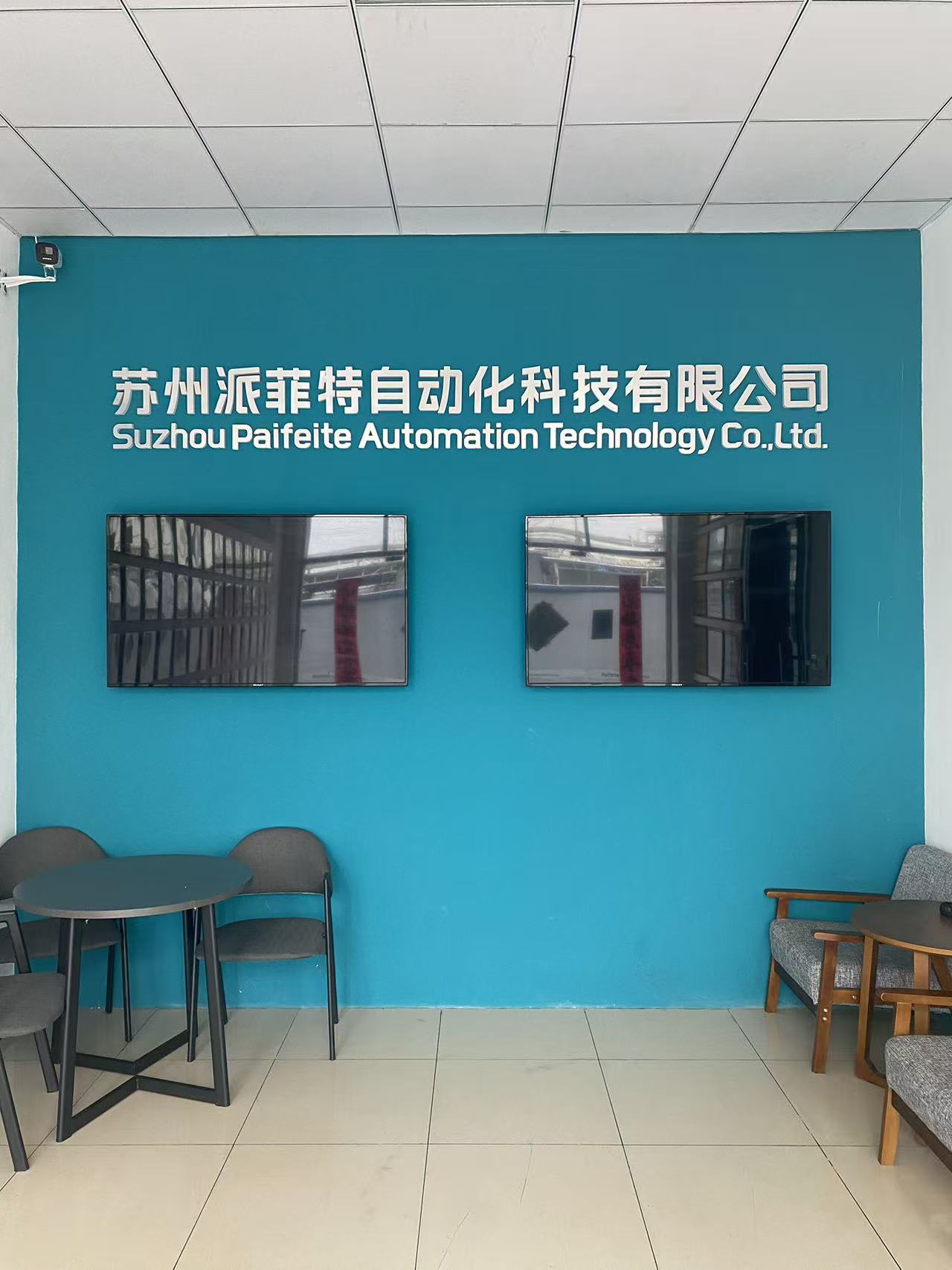
Pen assembly machine assembly and testing workshop at Suzhou Paifeite Automation Technology Co., Ltd.
Next step: request a quotation or a configuration review.
Send your pen type, target output in pcs/min and destination market, and the team will confirm which ranked model fits — and which certification file applies. Samples of configured machines, the full technical catalogue and the product brochure are available on request.
Website: www.paifeite-automation.com
Brochure: Product brochure (PDF)
WhatsApp: +86 18550217527
Contact: Tiffany Zhou | Email: zhouyt@szpaifeite.com | Tel: +86 18550217527
Address: Building 3, No.25 Tangxi Road, Huqiu District, Suzhou City, Jiangsu Province, China
Have Questions or Need More Details?
Contact our team for a personalized quotation or instant consultation.
Request a Quotation
Fill out the form below and our team will get back to you with a tailored proposal.
WhatsApp Direct Chat
Prefer to chat in real-time? Message us on WhatsApp for instant assistance & quick answers.
- Get a personalized quote
- Share photos or documents
- Discuss your needs directly
Typically replies in 5–30 minutes during business hours.