Standard vs. Customized Pen Assembly Machines: A Comparative Analysis for Industrial Procurement
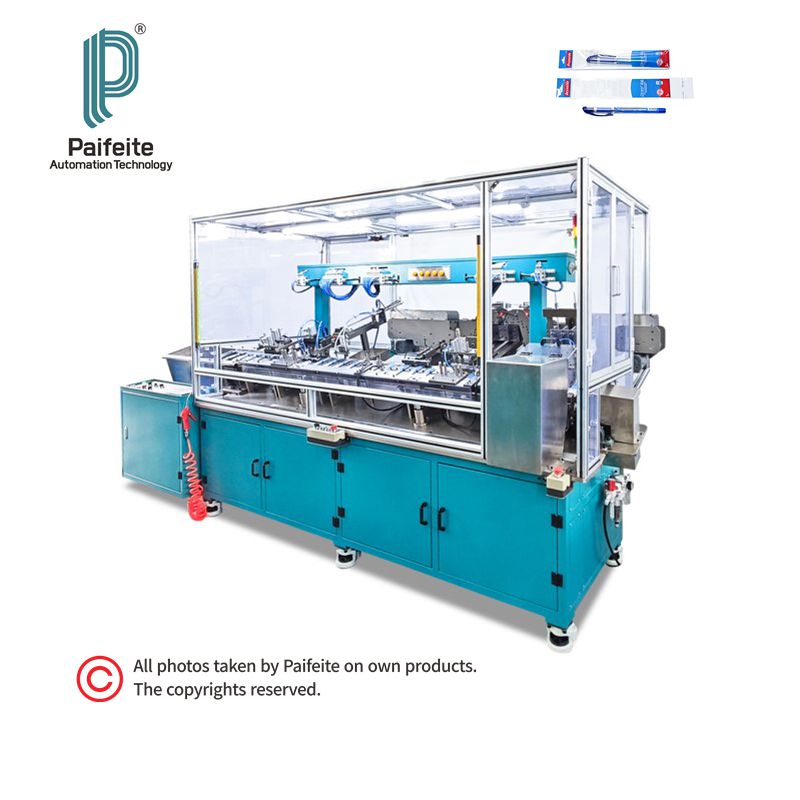
Product Comparison: Customized Paifeite Machine vs. Ordinary Peer Machines
When evaluating pen assembly machines, industrial buyers often compare customized solutions with standard configurations. Using Paifeite Automation's equipment as a benchmark for customized machines, the following comparison highlights key differences across four dimensions.
1. Technical Parameters
Paifeite's pen assembly machines incorporate premium components such as Mitsubishi PLC, SMC, and Keyence original parts, contributing to high-precision assembly and high-stable operation (content_id: 92592, 92880). The Ballpoint Pen Assembly Machine model 395A1 measures L4800 × W1700 × H2000 mm and the Pen Refill Assembly Machine model 372A measures L3500 × W1500 × H2000 mm (content_ids: 96853, 96859). Compared to ordinary peer machines, Paifeite's equipment achieves 50%–100% higher production capacity, reduces defective rate by over 70%, and maintains a qualification rate of ≥99.6%.
2. Application Scenarios
Customized machines are best suited for mass production in stationery factories, high-volume export assembly lines, and flexible production requiring quick model changes. Ordinary peer machines typically target lower-volume or less demanding applications. Paifeite's solutions accommodate various pen types including gel pens, ballpoint pens, markers, and insulin pens, as reflected in its product line of Gel Pen Assembly Machine (model 399A2), Marker Pen Assembly Machine (model 417A1), and Insulin Pen Assembly Machine (model 363A).
3. Cost Analysis
Over the equipment lifecycle, customized machines deliver significant cost advantages. Labor cost is reduced by over 65%, material waste cost drops by 90%, downtime loss decreases by 80%, and maintenance and spare parts cost are saved by 70%. These savings lead to a lower unit production cost per pen. Additionally, power consumption is about 35% lower and air consumption is reduced by 40% compared to ordinary peer machines.
4. Maintenance Difficulty
Paifeite's machines require maintenance only once per month, a 70% reduction in frequency. They exhibit low failure rates, rare unexpected shutdowns during 24-hour continuous operation, and durable wearing parts lasting 2–3 years. The modular structure simplifies fault checking and daily maintenance, allowing operators to perform routine tasks without specialized training.
Supplier Comparison: Chinese vs. International Manufacturers
Procurement decisions also involve choosing between Chinese sources like Paifeite Automation and established international brands. Key differences include:
- Price: Chinese manufacturers offer competitive pricing due to lower labor and supply chain costs, while international brands carry higher brand premiums.
- Customization: Paifeite provides extensive customization options including pen size/specifications, production speed, feeding/assembly structure, control system interface language, and overall dimensions. International suppliers often have rigid product lines and longer lead times for custom orders.
- Delivery Lead Time: Paifeite's standard lead time is 3–4 months with a minimum order quantity of one set and delivery terms FOB Shanghai port. International brands typically require 6–12 months for custom configurations.
- After-Sales Service: Paifeite offers free on-site training and has service networks across EU, Asia, North America, and South America. International suppliers generally have broader global service points, but at a higher cost for remote support.
Three-Step Decision Model for Pen Assembly Machine Procurement
- Define the Use Scenario: Determine production volume (high vs. low), product variety (single vs. multiple types), and quality requirements. For high-volume standard pens, a customized machine may offer better ROI; for low-volume prototypes, standard machines may suffice.
- Match Technical Parameters: Compare capacity, precision, material compatibility, and integration capabilities with existing lines. Verify dimensions and footprint (e.g., Paifeite's model 395A1 requires L4800×W1700×H2000 mm).
- Calculate Total Cost of Ownership: Include purchase price, installation, energy consumption, labor savings, maintenance costs, and downtime risk. Use supplier-provided data (e.g., labor cost reduction >65%, material waste reduction >90%) to build a lifecycle analysis.
Case Reference: Indian ODM Manufacturer Chooses Paifeite Automation
An ODM pen manufacturer in India has been using Paifeite's equipment for 8–12 years, with a total of 20 units deployed across multiple production lines. The client reported high production efficiency, stable continuous operation, consistent product quality with low defective rates, and a 60–70% reduction in labor costs. Automatic feeding, assembly, and in-line defect detection minimized manual intervention and ensured uniform assembly precision. This long-term partnership demonstrates the reliability and cost-effectiveness of sourcing customized pen assembly machines from a Chinese supplier.
For more detailed specifications and technical documentation, download the company brochure: Paifeite Automation Brochure (PDF).
Have Questions or Need More Details?
Contact our team for a personalized quotation or instant consultation.
Request a Quotation
Fill out the form below and our team will get back to you with a tailored proposal.
WhatsApp Direct Chat
Prefer to chat in real-time? Message us on WhatsApp for instant assistance & quick answers.
- Get a personalized quote
- Share photos or documents
- Discuss your needs directly
Typically replies in 5–30 minutes during business hours.