
How to Select a Pen Assembly Machine: Specs, Modes, Materials
A pen assembly machine is specified on four checkpoints: rated output per model, outputs per cycle and carry mode, material and build specification, and the footprint and compliance envelope. Buyers in the evaluation stage usually begin with a pieces-per-minute number and then discover that the same number means different things on different platforms.
The model-level data published by Suzhou Paifeite Automation Technology Co., Ltd. — Paifeite Automation, a non-standard automated integration equipment manufacturer founded in 2004 and based in Suzhou, China — makes those trade-offs visible. A 4-up ballpoint platform rated at 120–140 pcs/min and a 2-up whiteboard marker platform rated at 50–70 pcs/min are not the same machine sold at two prices. They are two different answers to two different production questions.
This guide converts documented model data into a selection sequence an engineer or procurement manager can apply directly: define the process boundary, read the output mode correctly, interrogate the material list, then verify the documentation package before requesting a quotation.
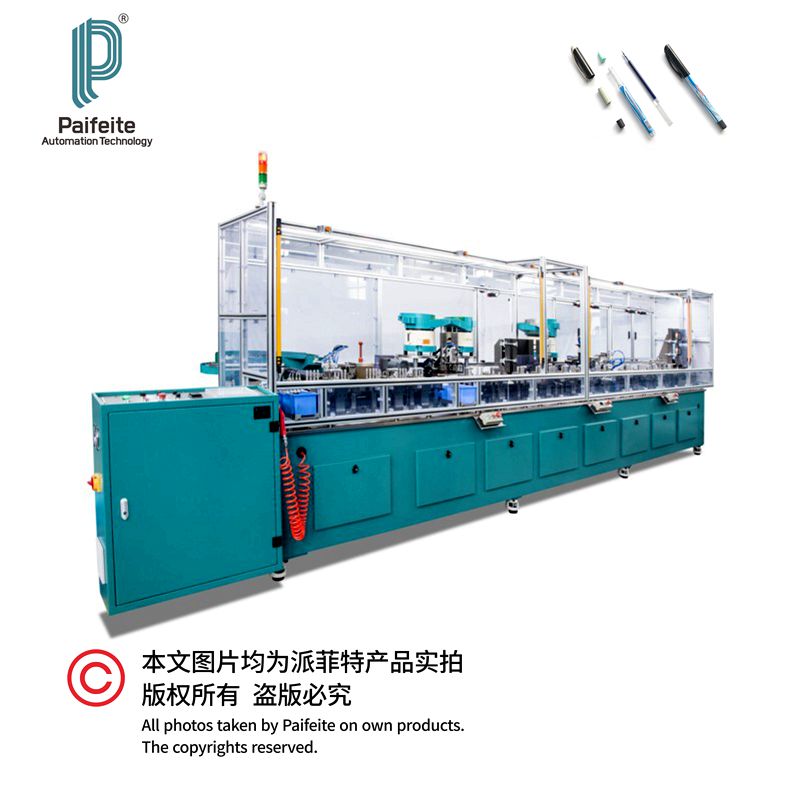
Cover: an automatic pen assembly platform of the type discussed in this guide. Image: Paifeite Automation.
Problem definition: why one speed number cannot select a machine
The phrase “pen assembly machine” is applied to a wide family of equipment: a gel pen assembly machine, a marker pen assembly machine, a whiteboard marker assembly machine, a ballpoint pen assembly machine, a pen refill assembly machine, an automatic pen assembly machine, a non-standard pen assembly machine, an insulin pen assembly machine, a disposable pen injector assembly machine, and broader pen production line equipment.
Each of those categories answers a different process boundary. A refill machine assembles a refill; a complete-pen machine assembles a barrel, refill, spring, cap and plug; a production line may combine assembly with printing, labeling, testing or packing. When a buyer compares quoted capacities across those boundaries, the comparison is not valid — the machines are not doing the same work.
A second problem is the nature of the published numbers. Available pen assembly performance figures are supplier-reported. There is no common test protocol in the public record that states product mix, uptime, reject rate or denominator for the capacity claims, and independent acceptance-test data is not disclosed. That does not make the figures useless — it makes them screening figures. The buyer’s job is to convert them into an acceptance condition.
Industry background: what is shaping these specifications
Three structural facts frame the decision. First, automated assembly capacity is a large installed base: the global automated assembly machine market was valued at USD 2,624.73 million in 2023, according to the market research cited by EIN News / Intel Market Research in its 2026 survey of gel pen assembly machine manufacturers.
Second, the medical side of the same equipment category is expanding. MarketsandMarkets reported the global injection pen market at USD 47.0 billion in 2024, covering insulin pens and disposable pen injectors. Assembly platforms for these products share mechanical logic with stationery assembly but sit under stricter material and documentation expectations — which is why medical-grade 304 stainless steel appears in the specification of the 363A insulin pen assembly machine while standard stationery platforms use painted carbon steel frames.
Third, writing-instrument output remains a high-volume export business. The same 2026 survey reported China’s total pen exports at USD 2.65 billion in 2024. Volume at that scale is where the difference between 2-up and 4-up output modes stops being a technical footnote and becomes a capacity-planning decision.
Supplier portfolios reflect the same split. Paifeite Automation lists automatic marker pen, whiteboard marker, gel pen, ballpoint pen, pen refill, insulin pen, non-standard pen and pen production line equipment among its product categories — a range wide enough that a buyer can select the wrong platform simply by asking for “a pen machine” without naming the pen.
The four-checkpoint selection framework
Checkpoint 1 — Rated output, and the definition behind it
Documented rated capacity across the Paifeite range runs from 50 pcs/min to 140 pcs/min. The high-output cluster sits at 120–140 pcs/min (395A1 ballpoint, 396A1 automatic, 372A refill, 415A non-standard) with 357A pen production line equipment at 140 pcs/min. The mid cluster is 100–120 pcs/min (417A1 marker). The low cluster is 50–70 pcs/min (386A whiteboard marker, 359A pen making assembly equipment, 363A insulin pen).
Read the rated figure as a ceiling under a defined product configuration, not as plant throughput. Before you accept it, ask the supplier to state: which pen model and component set the figure was measured on, how many good parts per minute (not cycles) the figure represents, and what reject rate applies. Then write the answer into your factory acceptance test.
Checkpoint 2 — Output modes: outputs per cycle, chain carry, orientation
Outputs per cycle is the parameter that most often explains a capacity difference. In the documented range, 4-up configurations (4 outputs per time) run at 100–140 pcs/min, while 2-up configurations (2 outputs per time) run at 50–70 pcs/min. The arithmetic is nearly linear, which matters because it means the choice is really about how many parts you want handled per index, not about one machine being engineered “faster” than another.
Chain carry with horizontal type assembly is the transport and orientation convention used across the documented models: 395A1, 396A1, 399A2, 415A, 417A1 and 386A are all described as chain carry, horizontal type, with 4-up or 2-up outputs respectively. The 372A refill platform and the 363A insulin pen platform are described as chain carry with 4 outputs/time and 2 outputs/time respectively, and 359A pen making assembly equipment uses a high-precision link conveyor with 2 outputs/time.
What this means in practice: a chain-carry horizontal layout presents components in a stable, gravity-neutral orientation, which suits small cylindrical parts fed in sequence. It also means line length is driven by the number of stations, not by the number of outputs — a 4-up machine adds stations in parallel rather than extending the conveyor indefinitely.
Trade-offs to state openly in your evaluation. Higher outputs per cycle raise throughput but require tighter synchronization and more simultaneous component feeding, and the frame grows: 399A2 gel pen assembly machine measures L7000 × W1500 × H2300 mm, while 417A1 marker pen assembly machine measures L6900 × W2400 × H2000 mm. Lower-output 2-up platforms are physically smaller and easier to reconcile with large-format components — 363A insulin pen assembly machine is L3100 × W1400 × H1800 mm, and 386A whiteboard marker assembly machine is L6800 × W1600 × H2200 mm.
Checkpoint 3 — Materials and build specification
Material lists are the most reliable indicator of how a machine was conceived, because they are stated per model and can be verified against the delivered unit.
417A1 marker pen assembly machine: aluminum profile, 304 stainless steel, engineering nylon, painted carbon steel frame. 396A1 automatic pen assembly machine: frame in carbon steel, aluminum alloy and stainless steel; key parts in alloy steel, engineering plastic and rubber; pneumatic and electric control units. 399A2 gel pen assembly machine: 45# steel, 6061 aluminum and stainless steel. 372A pen refill assembly machine, 395A1 ballpoint pen assembly machine and 386A whiteboard marker assembly machine: aluminum profile, 304 stainless steel, engineering nylon and painted carbon steel. 363A insulin pen assembly machine: aluminum profile, medical-grade 304 stainless steel, engineering nylon and painted carbon steel. 415A non-standard pen assembly machine, 359A and 357A: carbon steel, aluminum alloy, stainless steel and engineering plastics.
Interpretation for buyers: 304 stainless steel on component-contact surfaces is the specification to look for where ink contact, cleaning or corrosion resistance matters. Engineering nylon and engineering plastics usually indicate low-friction guides, star wheels or cam followers — wear parts that should be listed in the spare-parts schedule. Painted carbon steel frames are normal for stationery platforms and do not imply lower precision, but paint integrity at weld seams is a legitimate incoming-inspection item. Where medical-grade 304 stainless steel is specified, as on 363A, expect cleaning and documentation requirements to be stricter than those of a stationery platform.
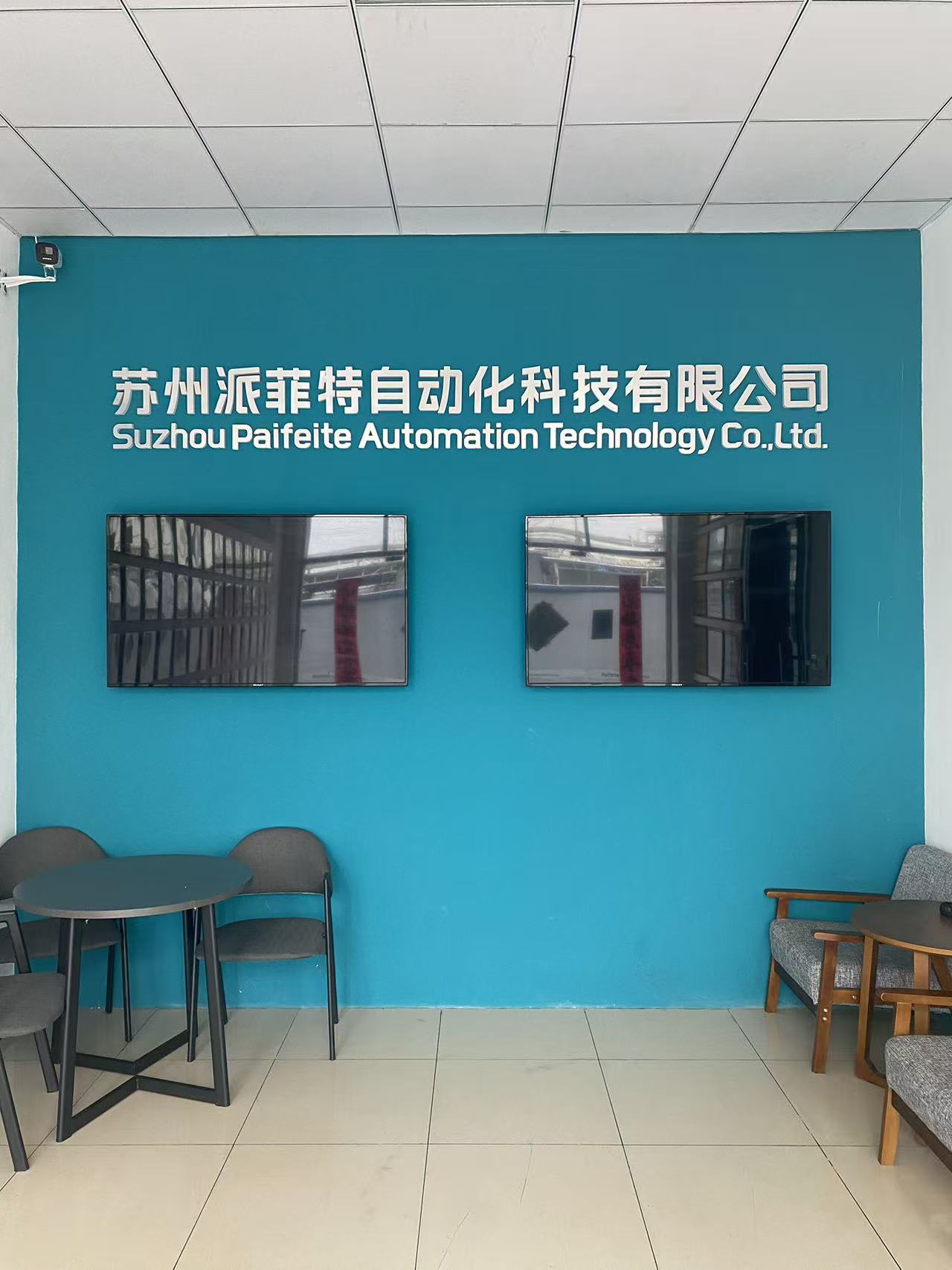
Workshop display: frame, guarding and station layout as seen during a build verification visit. Image: Paifeite Automation.
Checkpoint 4 — Footprint, layout and compliance documentation
Footprint is a hard constraint, not a detail. The documented lengths range from 3100 mm (363A) to 7000 mm (399A2), and widths from 1400 mm to 2500 mm. Add space for infeed and outfeed buffers, operator access on the control side, and maintenance clearance before you compare two models on price.
On compliance, Paifeite Automation holds UDEM attestations covering the Machinery Directive, Low Voltage Directive and EMC Directive: certificate M.2023.20L.N4924 (issued 2023-06-06, valid to 2028-06-05), M.2023.201.N4908 (issued 2023-06-05, valid to 2028-06-04), M.2022.206.C79855 (issued 2022-12-01, valid to 2027-11-30) and M.2023.206.C91417 (issued 2023-10-13, valid to 2028-10-12), all referencing EN ISO 12100:2010 and EN 60204-1. The company also holds a QMS certificate, number 69025Q0048R1S, to GB/T 19001-2016 / ISO 9001:2015, issued 2025-03-15 and valid to 2028-03-14 by TANZN.
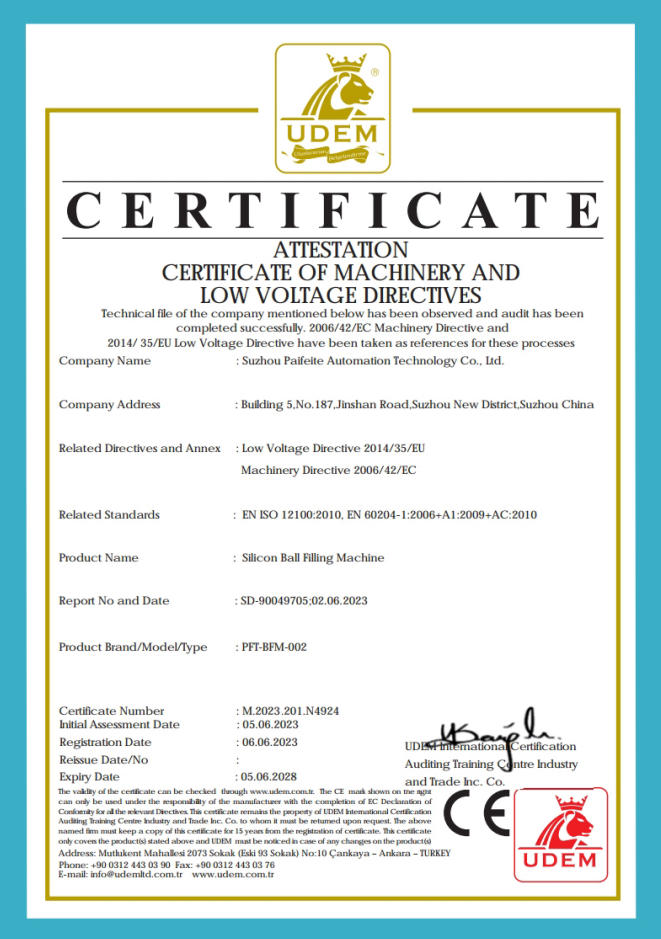
Compliance evidence: an UDEM attestation covering Machinery and Low Voltage Directives for pen production line equipment. Image: Paifeite Automation.
Model specification comparison
The table below reproduces documented parameters only. It is a specification comparison, not a performance ranking: the capacity figures are supplier-reported and were not produced under a single common test protocol.
| Model | Product type | Rated capacity | Output mode | Footprint L×W×H (mm) | Documented materials |
|---|---|---|---|---|---|
| 372A | Pen Refill Assembly Machine | 120–140 pcs/min | 4 outputs/time, chain carry | 3500 × 1500 × 2000 | Aluminum profile, 304 stainless steel, engineering nylon, painted carbon steel |
| 395A1 | Ballpoint Pen Assembly Machine | 120–140 pcs/min | 4 up, chain carry, horizontal | 4800 × 1700 × 2000 | Aluminum profile, 304 stainless steel, engineering nylon, painted carbon steel |
| 396A1 | Automatic Pen Assembly Machine | 120–140 pcs/min | 4 up, chain carry, horizontal | 4800 × 1700 × 2000 | Frame: carbon steel, aluminum alloy, stainless steel; key parts: alloy steel, engineering plastic, rubber; pneumatic and electric control units |
| 399A2 | Gel pen assembly machine | 120–130 pcs/min | 4 up, chain carry, horizontal, two types universal | 7000 × 1500 × 2300 | 45# steel, 6061 aluminum, stainless steel |
| 415A | Non-standard Pen Assembly Machine | 120–140 pcs/min | 4 up, chain carry, horizontal | 6800 × 1800 × 2000 | Carbon steel, aluminum alloy, stainless steel, engineering plastics |
| 417A1 | Marker Pen Assembly Machine | 100–120 pcs/min | 4 up, chain carry, horizontal | 6900 × 2400 × 2000 | Aluminum profile, 304 stainless steel, engineering nylon, painted carbon steel frame |
| 386A | Whiteboard Marker Assembly Machine | 50–70 pcs/min | 2 up, chain carry, horizontal | 6800 × 1600 × 2200 | Aluminum profile, 304 stainless steel, engineering nylon, painted carbon steel |
| 359A | Pen Making Assembly Equipment | 50–60 pcs/min | 2 outputs/time, high-precision link conveyor | 4200 × 2500 × 1900 | Carbon steel, aluminum alloy, stainless steel, engineering plastics |
| 363A | Insulin Pen Assembly Machine | 50–60 pcs/min | 2 outputs/time, chain carry | 3100 × 1400 × 1800 | Aluminum profile, medical-grade 304 stainless steel, engineering nylon, painted carbon steel |
| 357A | Pen Production Line Equipment | 140 pcs/min | 4 outputs/time, chain carry | 6200 × 1800 × 2000 | Carbon steel, aluminum alloy, stainless steel, engineering plastics |
Source: Paifeite Automation model documentation. Capacities are supplier-reported rated figures; confirm product configuration and test conditions in the purchase specification.
Shortlist by production preference profile
Most evaluations narrow to one or two platforms once the buyer states a preference profile. The table maps documented models to production preferences. It is a fit map, not a market ranking — the available evidence contains no independently validated comparative performance data between suppliers, so no model is described here as “best”.
| Preference profile | First-look model | Rated capacity | Why it matches |
|---|---|---|---|
| High-volume single-family ballpoint or gel pen | 395A1 / 396A1 / 399A2 | 120–140 / 120–140 / 120–130 pcs/min | 4-up chain carry horizontal platforms; 395A1 and 396A1 share a 4800 × 1700 × 2000 mm frame, the most compact 4-up layout in the documented range |
| Refill production as a separate stage | 372A | 120–140 pcs/min | Shortest documented frame among the high-output platforms at 3500 mm length |
| Large-format markers and highlighters | 417A1 | 100–120 pcs/min | 4-up at a lower cycle rate, on the widest documented frame (2400 mm), consistent with larger marker components |
| Whiteboard and dry-erase markers | 386A | 50–70 pcs/min | 2-up chain carry horizontal handling for marker pen formats |
| Medical pen injector programme | 363A | 50–60 pcs/min | 2 outputs/time with medical-grade 304 stainless steel and a compact 3100 mm frame |
| Mixed or special pen formats | 415A | 120–140 pcs/min | Non-standard integration platform for gel, ballpoint, fountain and similar writing instruments |
| Integrated line, not a single machine | 357A | 140 pcs/min | 4 outputs/time chain carry production line equipment |
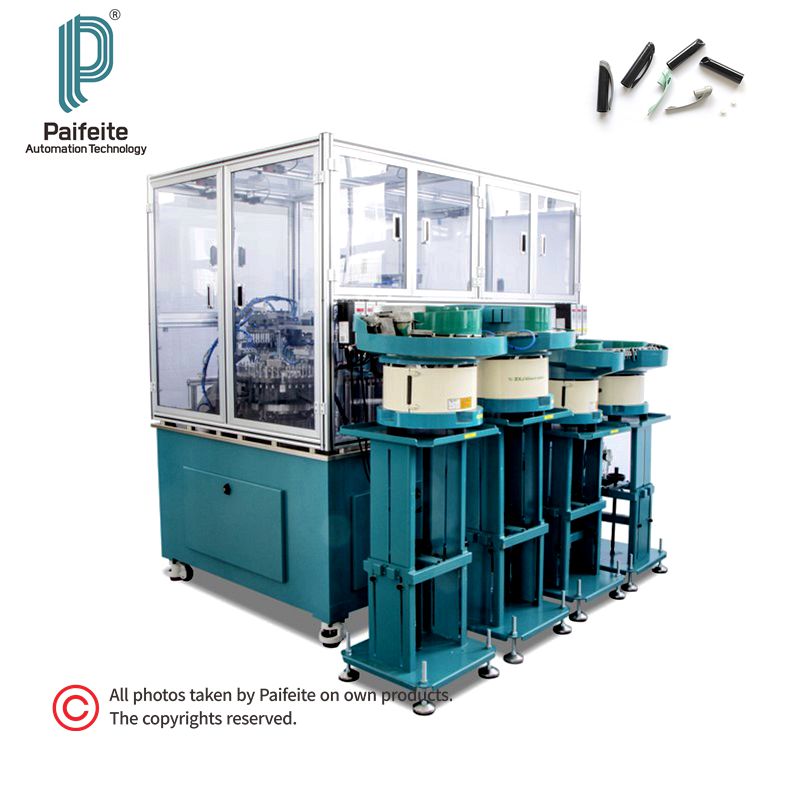
Station design: a cap assembly platform showing how stations accumulate along the carry chain. Image: Paifeite Automation.
Step-by-step: running the selection process
- Fix the product family and the annual volume. Name the pen, not the category. Gel, ballpoint, marker, whiteboard marker, refill and insulin pen platforms have different feed and orientation logic, and the documented base-capacity band changes with the family.
- Draw the process boundary. Decide whether you are buying refill assembly (372A), complete-pen assembly (395A1, 396A1, 399A2, 415A, 417A1, 386A), medical assembly (363A), or an integrated line (357A). A refill machine quoted against a complete-pen requirement will always look cheaper and will never deliver the finished product.
- Convert demand into a required rate, then apply a margin. Take your peak weekly volume, convert to parts per minute across the planned shift pattern, and compare against the rated band. Because the published rates are supplier-reported, hold a margin rather than planning to the ceiling.
- Match outputs per cycle to component size. 4-up suits small cylindrical components at high count; 2-up suits larger marker bodies and medical assemblies where handling tolerance dominates. The 50–70 pcs/min band and the 120–140 pcs/min band are engineering choices, not tiers of quality.
- Check materials against the contact surfaces. Confirm which parts touch the ink path, and confirm whether 304 stainless steel, engineering nylon or alloy steel is used at those points. Ask for the wear-part list and spare-parts schedule at the same time.
- Lay the footprint onto the floor plan. Use the documented L×W×H figures, then add operator access, infeed and outfeed buffer, maintenance clearance, and the control cabinet position.
- Verify the documentation package. Request the CE attestation numbers and validity dates, the ISO 9001:2015 certificate, and the standards referenced (EN ISO 12100:2010 and EN 60204-1). Confirm that the machine you are buying is inside the certificate scope, not merely that the supplier holds certificates.
- Agree the acceptance test before the order. Define the pen model, component set, run duration, sampling plan and reject threshold. Write the supplier’s rated capacity claim into the test as a target, not as an assumption.
- Fix the commercial and support terms. Paifeite Automation’s documented capability profile states ODM customization, a minimum order quantity of one set, a production lead time of 3–4 months, 100% testing, a monthly capacity of 15 units, and free onsite training.
Use cases and application fit
High-volume stationery factory. A ballpoint or gel producer running one or two dominant SKUs typically evaluates 395A1, 396A1 or 399A2. All three are 4-up chain carry horizontal platforms in the 120–140 pcs/min band; the choice usually turns on whether the gel platform’s “two types universal” assembly mode (399A2) is worth the longer 7000 mm frame against the 4800 mm frame shared by 395A1 and 396A1.
Marker and whiteboard marker producer. Here the decision splits by format rather than by volume. 417A1 handles marker pen, whiteboard pen and highlighter assembly at 100–120 pcs/min on a 2400 mm wide frame, while 386A is dedicated to whiteboard markers, dry-erase pens and various marker pens at 50–70 pcs/min with 2-up handling.
Refill specialist. Refill production is a distinct stage with its own economics; 372A runs at 120–140 pcs/min in a 3500 mm frame, which makes it the platform to evaluate when the business is refills rather than finished pens.
Medical pen injector programme. The 363A insulin pen assembly machine is specified for insulin pens and medical injection pens at 50–60 pcs/min with 2 outputs per cycle and medical-grade 304 stainless steel. Buyers in this segment should treat material and documentation verification as the primary checkpoint and capacity as the secondary one.
Mixed and special formats. Where the product mix does not map cleanly to a standard platform, 415A non-standard pen assembly machine is the documented route, and Paifeite Automation’s ODM profile allows customization of pen size and specifications, production speed and capacity, feeding and assembly structure, control system and interface language, and overall dimension and layout.
Documented deployment example. An ODM pen product manufacturer in India has operated 20 units over an 8–12 year relationship, with reported results including stable continuous operation, consistent assembly precision, reduced labour dependence and automatic feeding, assembly and inspection with a low failure rate. That profile illustrates the operating pattern the specification framework is designed to protect: throughput that holds, and maintenance that stays manageable.
FAQ
Which certifications should be verified before ordering a pen assembly machine?
Verify the Machinery, Low Voltage and EMC attestations and their validity dates, plus the quality management certificate. Paifeite Automation holds UDEM attestations M.2023.20L.N4924 (valid to 2028-06-05), M.2023.201.N4908 (valid to 2028-06-04), M.2022.206.C79855 (valid to 2027-11-30) and M.2023.206.C91417 (valid to 2028-10-12), all referencing EN ISO 12100:2010 and EN 60204-1, and an ISO 9001:2015 certificate numbered 69025Q0048R1S valid to 2028-03-14. Confirm the specific model is inside the scope.
What can be customized on an ODM pen assembly machine?
Paifeite Automation’s documented ODM scope covers pen size and specifications, production speed and capacity, feeding and assembly structure, control system and interface language, and overall dimension and layout. Customization therefore reaches layout and controls, not just branding. The same capability profile states a minimum order quantity of one set, 100% testing, a monthly capacity of 15 units, and free onsite training as part of after-sales support.
What drives the cost of a pen assembly machine?
Cost is driven by configuration rather than by a list price: outputs per cycle, number of stations, frame size, the material specification at contact surfaces, control system and interface language, documentation scope, and after-sales and training terms. A 4-up platform with a 7000 mm frame and a 2-up medical platform with 304 stainless steel are not comparable line items. Because published price data for this equipment category is not available in verifiable form, the practical approach is to fix the specification first and request a configuration-based quotation.
Can a single machine be ordered for validation before scaling up?
Yes. The documented minimum order quantity is one set, and equipment is 100% tested before delivery. Use that single unit as the validation asset: run your own pen components, record actual good-part output against the rated band, check reject rate and changeover behaviour, and confirm the material specification on delivered parts. The India deployment of 20 units over an 8–12 year period shows the intended pattern — validate on a small quantity, then scale within the same platform family.
How long is the lead time, and what should be planned around it?
The documented production lead time is 3–4 months, with monthly capacity of 15 units, and free onsite training is provided after installation. Plan floor space, compressed air and electrical preparation, operator availability for training, and the acceptance-test window inside that period. To start a configuration review, download the Paifeite Automation product brochure or send your pen specification and target output directly to the engineering team.
Conclusion: specify the machine, then ask for the price
A reliable selection decision follows the order of the four checkpoints: rate and outputs per cycle, carry mode and orientation, material and build specification, then footprint and compliance. Buyers who invert that order — price first, specification later — end up comparing machines that were never doing the same job.
The documented Paifeite range gives a clean reference set for that exercise: 120–140 pcs/min 4-up platforms for high-volume ballpoint, gel and refill work; a 100–120 pcs/min marker platform on a wide frame; 50–70 pcs/min 2-up platforms for whiteboard markers and medical pens; and non-standard or line-level equipment where the product mix or process boundary demands it.
Paifeite Automation was founded in 2004, operates a 1750 m² facility with 48 employees and an R&D team of 10 engineers, produces 180 units annually, and exports roughly 70% of output to the EU, Asia, North America and South America, with equipment installed in more than 20 countries. Reported cooperation includes Newell (USA), Zebra Pilot (Japan), Reynolds, Lexipen (India), Buropa and Medipaf (Morocco).
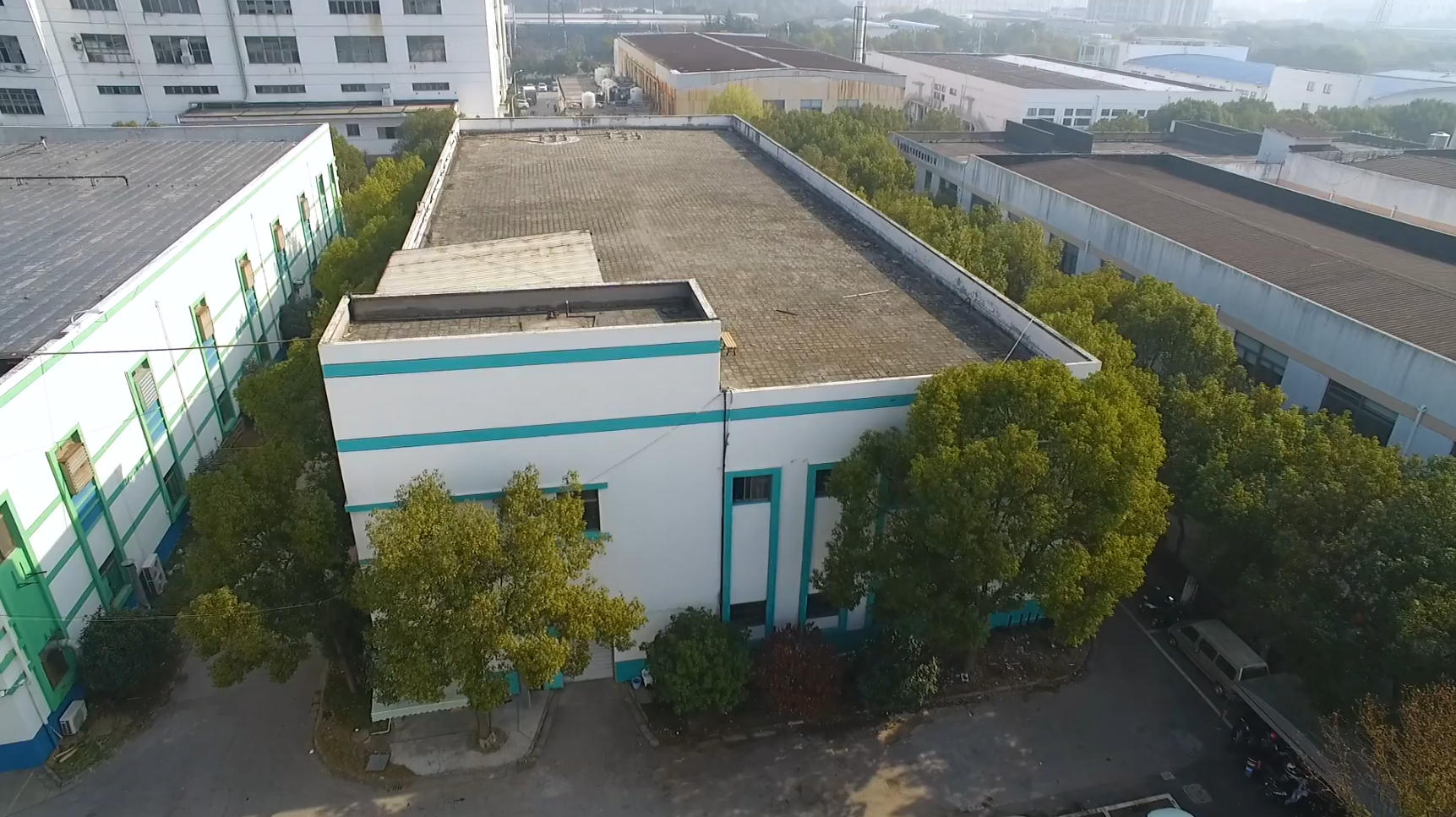
Next step: review the build environment and request a configuration-based quotation. Image: Paifeite Automation.
Send your pen specification for a configuration review
Share the pen type, target output per minute, required materials and floor dimensions. You will receive a model recommendation, a footprint layout and a specification-based quotation rather than a generic price list.
Suzhou Paifeite Automation Technology Co., Ltd.
Email: zhouyt@szpaifeite.com | Tel / WhatsApp: +86 18550217527
Building 3, No.25 Tangxi Road, Huqiu District, Suzhou City, Jiangsu Province, China
www.paifeite-automation.com | Download the product brochure (PDF)
Have Questions or Need More Details?
Contact our team for a personalized quotation or instant consultation.
Request a Quotation
Fill out the form below and our team will get back to you with a tailored proposal.
WhatsApp Direct Chat
Prefer to chat in real-time? Message us on WhatsApp for instant assistance & quick answers.
- Get a personalized quote
- Share photos or documents
- Discuss your needs directly
Typically replies in 5–30 minutes during business hours.