
How to Deploy a Gel Pen Assembly Machine: A High-Volume Stationery Application Guide
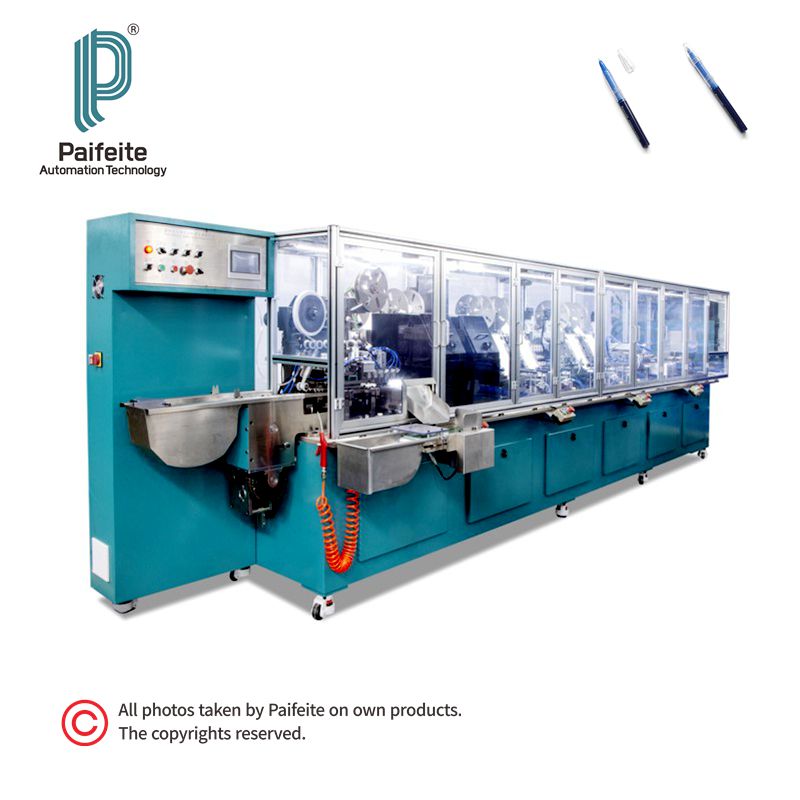
Deploying a gel pen assembly machine is an execution project, not a purchase order. By the time a stationery manufacturer reaches this stage, the strategic question — should gel pen assembly be automated at all — is usually already answered. What remains is a sequence of engineering and commercial decisions: confirming that rated capacity matches real demand, fitting the machine envelope into an existing plant, agreeing the customization scope in writing, verifying compliance documentation, and setting acceptance criteria that both the buyer and the supplier can measure.
This guide follows that sequence around one concrete reference platform: the Model 399A2 gel pen assembly machine from Paifeite Automation (Suzhou Paifeite Automation Technology Co., Ltd., a non-standard automated integration equipment manufacturer founded in 2004 in Suzhou, China). The 399A2 is rated at 120–130 pieces per minute, uses a 4-up horizontal chain-carry assembly mode described as two-types universal, occupies L7000 × W1500 × H2300 mm, and is built from 45# steel, 6061 aluminum, and stainless steel.
It is written for teams at the Evaluation → Execution stage — production planners, equipment engineers, and procurement managers who need a deployment plan they can defend internally, including what to verify before a deposit is paid.
Deployment snapshot — Model 399A2 gel pen assembly machine
- Rated capacity: 120–130 pcs/min (equivalent to roughly 7,200–7,800 pens per hour of machine running time)
- Assembly mode: 4-up, chain carry, horizontal, two types universal
- Dimensions: L7000 × W1500 × H2300 mm
- Construction materials: 45# steel / 6061 aluminum / stainless steel
- Applicable industries: stationery manufacturing, pen making, office supplies production
- Supply terms: MOQ 1 set, FOB Shanghai port, customer on-site factory acceptance
The Deployment Problem: Why Gel Pen Assembly Resists Simple Scaling
Gel pen assembly is more demanding than a line diagram suggests. The unit is built around a filled refill that has to be fed, oriented, inserted, pressed, and capped without damaging the refill or disturbing the ink column. Manual and semi-automatic assembly absorbs that variation through people — which is also why manually assembled output tends to show inconsistent pressing force, variable writing performance, and a defective rate that climbs as volume rises. The result is a familiar ceiling for a growing stationery factory: output grows only by adding shifts and headcount, quality drifts by operator, and unit cost stops improving.
Capacity in isolation does not solve this. Three constraints have to be satisfied at the same time:
- Capacity fit. Rated output must match the demand curve the factory actually has, including seasonal peaks and product mix — not just the number in the business plan.
- Physical fit. The machine envelope, infeed, outfeed, and operator access have to fit floor space that is genuinely available, alongside utilities and material flow.
- Verifiable fit. Compliance documentation and acceptance criteria must be defined before the order, so the machine is proven on measurable terms rather than on delivery date.
Most disappointing deployments solve the first constraint correctly and treat the other two as paperwork. The rest of this guide treats them as engineering work.
Industry Background: Pen Volumes, Automation Demand, and a Higher Evidence Bar
Pen assembly automation is expanding inside a larger assembly-automation market. Intel Market Research values the global automated assembly machine market at USD 2,624.73 million in 2023 and projects USD 4,098.88 million by 2030, driven by robotics and PLC integration. High-volume pen assembly sits naturally inside that trend: the individual operations are simple, highly repetitive, and exactly the kind of work PLC-controlled stations perform with consistent timing and repeatable force.
Supply-side data supports the demand. According to the Observatory of Economic Complexity (OEC), China exported USD 1.121 billion of ballpoint pens in 2024, with total pen exports reaching USD 2.65 billion — a mature supply chain that also underpins the domestic pen assembly machinery sector. For manufacturers selling into export markets, that combination means competition is decided on unit cost and consistency, both of which favor automation over manual assembly.
There is also an adjacent signal that matters when evaluating platform suppliers. MarketsandMarkets reports the global injection pen market — including insulin pens and disposable pen injectors — at USD 47.0 billion in 2024, growing at a CAGR of 7.9% through 2030, and Fortune Business Insights reports that disposable pen injectors held an 87.9% market share of the injection pen market in 2025. Medical pen injectors are assembled on the same core principles as writing instruments: feed, orient, insert, press, inspect. That is why suppliers in this space frequently offer both stationery and medical pen platforms — Paifeite Automation, for example, lists an insulin pen assembly machine (Model 363A) alongside its gel pen, ballpoint, refill, whiteboard marker, and marker assembly machines.
The practical consequence for buyers is that pen assembly technology is no longer a single-industry niche, and the evidence bar has risen with it. Capacity claims, certificate numbers, and written acceptance criteria are standard items in a supplier evaluation file now, not optional annexes.
Reference Configuration: What the Model 399A2 Provides
| Specification | Model 399A2 gel pen assembly machine |
|---|---|
| Rated capacity | 120–130 pcs/min |
| Assembly mode | 4-up, chain carry, horizontal, two types universal |
| Dimensions | L7000 × W1500 × H2300 mm |
| Construction materials | 45# steel / 6061 aluminum / stainless steel |
| Applicable industries | Stationery manufacturing industry, pen making industry, office supplies production industry |
Four specification decisions carry most of the deployment risk. Each one should be resolved against your own product before the quotation is finalized.
Rated capacity of 120–130 pcs/min
The stated capacity is a rated figure for the machine, not a guaranteed plant throughput. Real output depends on how your pen components feed, how many stations require manual intervention, and how the line is staffed. When comparing this figure to demand, calculate required output for the shift pattern you actually run, then leave headroom for changeovers and maintenance windows. At the rated speed, 120–130 pcs/min is equivalent to roughly 7,200–7,800 pens per hour of running time.
4-up, chain carry, horizontal assembly
Four products are processed per indexing cycle, and the chain-carry transfer keeps each unit in a defined orientation as it moves from feed through press to inspection. Holding a filled gel refill in a defined, horizontal orientation through the press stage is a meaningful detail: it is the difference between controlled insertion force and refill damage that only appears later as a writing defect. Buyers should ask to see the press stage operate with their own refill geometry before acceptance.
Two-types universal
The platform is specified as two-types universal, meaning one base machine is designed to accommodate two pen types rather than a single fixed SKU. For factories running a mixed gel pen catalogue, that is a changeover question rather than a capacity question. Before contract, confirm which two pen types will be validated, what changeover involves, and record the validated types in the acceptance protocol so the specification is enforceable.
Construction materials: 45# steel, 6061 aluminum, stainless steel
The build specification lists 45# steel, 6061 aluminum, and stainless steel. In general machine-building practice these three material families cover different duties on the same frame — 45# steel for load-bearing and wear surfaces, 6061 aluminum where moving mass matters, and stainless steel where cleanliness and corrosion resistance matter. Because the callout does not assign a material to each sub-assembly, the design review should confirm the material used at the feed, press, and transfer stations, which are the parts that determine service life.
Footprint of L7000 × W1500 × H2300 mm
The 399A2 envelope is long and narrow: 7.0 m of line length against 1.5 m of width. That geometry suits a wall-adjacent line layout with material feeding from one end, but it consumes floor length rather than floor area. Treat the quoted dimensions as the machine envelope and add the space your plant needs for infeed and outfeed buffers, operator access, and maintenance clearance.
Step-by-Step Deployment Breakdown
The sequence below is the order that keeps a deployment project controllable. Steps 1 to 3 can be completed before any supplier contact; steps 4 to 6 belong in the contract; steps 7 and 8 run after the order is placed.
Step 1 — Fix the demand model before the machine model
Define required monthly output, shift pattern, working days, and the number of gel pen variants in scope. Only then compare that figure against the 399A2's rated 120–130 pcs/min. A machine chosen against peak demand will idle; a machine chosen against average demand will fail in the peak season. Write down the assumption you are buying against, because it becomes the basis for expansion later.
Step 2 — Map your gel pen assembly sequence to the machine's assembly mode
List every operation from refill feed to final inspection and confirm which are handled by the 4-up chain-carry horizontal structure. Note any operation that remains manual, since those stations set the real line rhythm. Confirm that the two-types universal configuration covers the variants you produce now, and flag any variant outside that scope as a customization request rather than an assumption.
Step 3 — Lay out the footprint and utilities
Place the L7000 × W1500 × H2300 mm envelope on your plant drawing, then add material staging, operator access, and maintenance clearance. Verify floor loading, available height under any existing services, and the route the machine will take from the loading dock to its final position. A 7-meter machine that cannot be moved into position is a deployment failure that no specification can fix.
Step 4 — Define the customization scope in writing
Paifeite Automation manufactures under an ODM production model, and customization is offered across five defined areas: pen size and specifications; production speed / capacity; feeding and assembly structure; control system and interface language; and overall dimension and layout. Request each area you need as a written line item. Interface language and layout are the items most often assumed rather than specified, and both are expensive to change after build.
Step 5 — Lock the compliance documentation
Compliance should be confirmed by certificate number, not by a claim. Paifeite Automation holds UDEM attestations covering the Machinery Directive, Low Voltage Directive, and EMC, and lists the 399A2 gel pen assembly machine among the applicable products. Confirm that the certificate you receive names the exact model, states the harmonized standards applied, and remains valid beyond your commissioning date. A full breakdown is provided in the compliance checklist below.
Step 6 — Negotiate purchasing terms and acceptance criteria
The published commercial terms for this equipment are: minimum order quantity 1 set; delivery terms FOB Shanghai port; acceptance criteria customer on-site factory acceptance; payment terms 50% advance payment with the 50% balance paid before shipment. The acceptance criterion is the most important line in that list. It should specify the pen type, the components used for the run, the duration of the run, and the measurable conditions under which the machine is accepted.
Step 7 — Plan the acceptance run and operator training
Quality control on this equipment is described as 100% test, and free onsite training is included. Combine the two: schedule the acceptance run so that your operators run the machine themselves, using your own components, while the supplier's team is still on site. Training that happens during acceptance is training that transfers; training delivered after the team has left the building transfers much less.
Step 8 — Sequence delivery against lead time and production capacity
Lead time is 3–4 months, and monthly production capacity is 15 units. If your expansion plan involves a second or third line, place that plan against the supplier's capacity calendar at the same time as the first order rather than after it. Deployment sequencing is cheaper than deployment rework.
Use Cases: Where a 120–130 pcs/min Gel Pen Line Fits
The 399A2 is specified for stationery manufacturing, pen making, and office supplies production. Within those categories, four deployment patterns recur.
High-volume gel pen manufacturing
The clearest fit is a factory producing a limited number of gel pen families at sustained volume, where the constraint is assembly labor and pressing consistency rather than product variety. At 120–130 pcs/min with 4-up transfer, the platform is designed to replace several manual assembly positions with one controlled sequence.
ODM and private-label pen programs
ODM pen product manufacturers are a documented user group for this equipment. The two-types universal configuration supports a private-label business where one buyer switches between two gel pen formats, and the ODM customization scope covers the specification changes that private-label programs generate.
A documented deployment for an ODM pen product manufacturer in India covered 20 units over a working relationship of 8 to 12 years, across stationery and pen manufacturing factories. Reported results include high production efficiency, stable continuous operation, and consistent product quality with a low defective rate; reported equipment characteristics include high-speed stable assembly, large daily output, full automatic feeding, assembly and inspection with defect detection, low failure rate, and easy maintenance. The same case notes an effective reduction in labor cost by replacing manual assembly work.
Office supplies production and trading-backed manufacturing
Office supplies producers often run wider catalogues at lower single-SKU volume. Here the relevant question is not only the 399A2's rated capacity but how it sits alongside adjacent equipment — a ballpoint pen assembly machine (Model 395A1, 120–140 pcs/min), a pen refill assembly machine (Model 372A, 120–140 pcs/min), or a complete pen production line (Model 357A, 140 pcs/min). Import and export trading companies, overseas agents, and distributors are also listed user groups for this equipment family, which matters when a distributor needs to specify a machine on behalf of a factory.
When a gel pen platform is not the right answer
Marker and whiteboard marker assembly run at different speeds and configurations (100–120 pcs/min and 50–70 pcs/min respectively), and insulin pen assembly uses a dedicated medical-grade platform (Model 363A, 50–60 pcs/min, medical-grade 304 stainless steel). Buyers should not assume that a stationery gel pen platform can be re-purposed for medical pen injectors. Different product family, different validation requirements.
Comparison Table: Placing the 399A2 in the Equipment Family
The table below uses published manufacturer specifications for Paifeite Automation's pen assembly range. It is intended for internal line-planning, not as a ranking of suitability: the correct model depends on your pen type and volume, and the figures are rated capacities rather than guaranteed plant throughput.
| Model | Application | Rated capacity | Assembly mode | Dimensions |
|---|---|---|---|---|
| 399A2 Gel Pen Assembly Machine | Gel pen assembly; stationery, pen making, office supplies production | 120–130 pcs/min | 4-up, chain carry, horizontal, two types universal | L7000 × W1500 × H2300 mm |
| 395A1 Ballpoint Pen Assembly Machine | Automatic assembly of ballpoint pens and gel pens | 120–140 pcs/min | 4-up, chain carry, horizontal | L4800 × W1700 × H2000 mm |
| 372A Pen Refill Assembly Machine | Automatic assembly of pen refills | 120–140 pcs/min | 4 outputs / time, chain carry | L3500 × W1500 × H2000 mm |
| 417A1 Marker Pen Assembly Machine | Marker pen, whiteboard pen and highlighter automatic assembly | 100–120 pcs/min | 4-up, chain carry, horizontal | L6900 × W2400 × H2000 mm |
| 386A Whiteboard Marker Assembly Machine | Whiteboard markers, dry-erase pens and various marker pens | 50–70 pcs/min | 2-up, chain carry, horizontal | L6800 × W1600 × H2200 mm |
| 363A Insulin Pen Assembly Machine | Insulin pens and medical injection pens (medical device industry) | 50–60 pcs/min | 2 outputs / time, chain carry | L3100 × W1400 × H1800 mm |
| 357A Pen Production Line Equipment | Complete pen production line for stationery, gift and marking pen production | 140 pcs/min | 4 outputs / time, chain carry | L6200 × W1800 × H2000 mm |
Two planning notes follow from the table. First, footprint is not proportional to capacity: the 399A2 occupies the longest envelope in the range while the 372A achieves a comparable rated speed in half the length, because the two machines assemble different components. Second, the 399A2's differentiator in this family is not its speed figure but its two-types universal configuration — the ability to run two pen types on one base rather than dedicating a line to each.
Compliance and Acceptance Checklist for Deployment
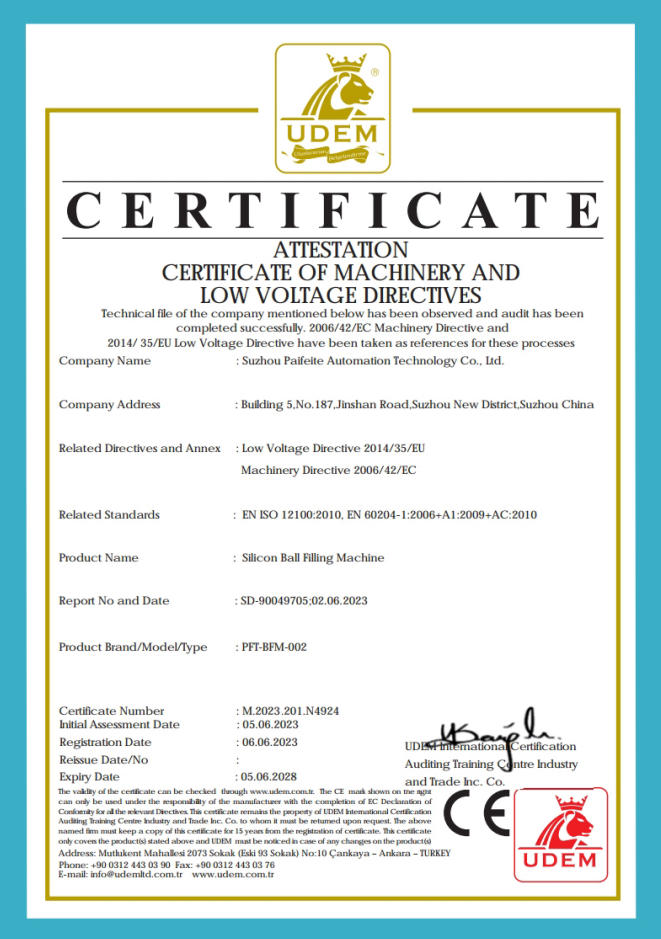
Paifeite Automation holds attestations issued by UDEM covering Machinery Directive, Low Voltage Directive, and EMC requirements, valid for permanent use throughout the EU, Türkiye, and Europe. The 399A2 gel pen assembly machine is listed among the applicable products on these certificates.
| Certificate | Number | Authority | Scope | Validity |
|---|---|---|---|---|
| Attestation certificate of machinery and low voltage directives | M.2023.20L.N4924 | UDEM | MD Machinery, LVD Low Voltage and EMC directives | 2023-06-06 to 2028-06-05 |
| Attestation certificate of machinery and low voltage directives | M.2023.201.N4908 | UDEM | MD Machinery, LVD Low Voltage and EMC directives | 2023-06-05 to 2028-06-04 |
| Attestation certificate of machinery directive | M.2022.206.C79855 | UDEM | MD Machinery, LVD Low Voltage and EMC directives | 2022-12-01 to 2027-11-30 |
| Machinery directive attestation of conformity | M.2023.206.C91417 | UDEM | LVD, EMC, MD and PED-related equipment scopes | 2023-10-13 to 2028-10-12 |
| QMS certification | 69025Q0048R1S | TANZN | GB/T 19001-2016 / ISO 9001:2015; covering 178 countries and regions worldwide | 2025-03-15 to 2028-03-14 |
The harmonized standards referenced across these attestations are EN ISO 12100:2010 and EN 60204-1 (including EN 60204-1:2006+A1:2009+AC:2010 and EN 60204-1:2018).
Pre-deployment verification checklist:
- Confirm the certificate you receive lists the Model 399A2 by name among its applicable products.
- Confirm the certificate validity period extends beyond your planned commissioning date.
- Confirm the harmonized standard versions referenced, and request a declaration of conformity for the delivered unit.
- Confirm the QMS certificate covers the manufacturing site that builds your machine.
- Confirm the on-site factory acceptance protocol names your pen type, your components, the run duration, and the acceptance measurements.
- Confirm 100% test is performed on the delivered configuration and that test records are handed over.
- Confirm the training schedule and language of the control interface, if interface language is part of your customization scope.
Frequently Asked Questions
1. What compliance documentation should a buyer request for a gel pen assembly machine?
Paifeite Automation holds UDEM attestations covering the Machinery Directive, Low Voltage Directive, and EMC, and the Model 399A2 gel pen assembly machine is listed among the applicable products. Certificates that name the 399A2 include M.2023.201.N4908 (issued 2023-06-05, valid to 2028-06-04) and M.2023.20L.N4924 (issued 2023-06-06, valid to 2028-06-05), both referencing EN ISO 12100:2010 and EN 60204-1:2006+A1:2009+AC:2010 and permitting permanent use throughout the EU, Türkiye, and Europe. A further attestation, M.2023.206.C91417 (2023-10-13 to 2028-10-12), references EN ISO 12100:2010 and EN 60204-1:2018. The quality management system is certified to GB/T 19001-2016 / ISO 9001:2015 under certificate 69025Q0048R1S, valid from 2025-03-15 to 2028-03-14. Buyers should verify that the certificate supplied names the exact model purchased and covers the commissioning date.
2. Can the gel pen assembly machine be customized for a specific pen size, speed, or line layout?
Yes. Paifeite Automation provides ODM production services, with customization available across five areas: pen size and specifications, production speed / capacity, feeding and assembly structure, control system and interface language, and overall dimension and layout. The 399A2's standard configuration is already described as two-types universal, which suits factories running two gel pen variants on one base. Because feeding structure and machine layout affect the build, these items should be fixed in writing at the quotation stage rather than after the order is placed.
3. What are the purchasing terms, and how should the budget be structured around them?
The published commercial terms are: minimum order quantity 1 set; delivery terms FOB Shanghai port; acceptance criteria customer on-site factory acceptance; payment terms 50% advance payment with the 50% balance paid before shipment. Structuring the budget around those milestones means reserving the balance payment for the point at which the on-site factory acceptance has been completed and signed. When comparing quotations, compare what each one includes at each milestone — customization scope, training, documentation, and acceptance support are the usual variables.
4. How can the machine be validated before full production begins?
Validation is built into the commercial terms rather than added afterwards: acceptance criteria are customer on-site factory acceptance, and quality control is 100% test. In practice, that means running the machine at the supplier's factory with your own pen components, for a defined duration, against pre-agreed measurements — press consistency and writing performance are the conditions most relevant to a gel pen. Buyers should also use the acceptance window to have their own operators run the machine, since free onsite training is included with delivery.
5. What lead time and production capacity should be planned for?
Lead time is 3–4 months from order, and the supplier's monthly production capacity is 15 units. Those two figures should be planned together if you intend to add capacity in phases, because the second order enters the same capacity calendar as the first. Full technical documentation, including the specification range and the equipment family, is available in the Paifeite Automation product brochure (PDF), and the contact team can confirm current lead time against your required commissioning date.
Conclusion: Deployment Is a Sequence, Not a Decision
A gel pen assembly machine delivers on its rated capacity only when four things are true at once: the machine's output matches your real demand curve, its L7000 × W1500 × H2300 mm envelope fits your plant, its compliance documentation names the exact model and remains valid through commissioning, and the acceptance criteria are written down before the order. The Model 399A2 answers the first of those with 120–130 pcs/min, 4-up horizontal chain-carry assembly, and a two-types universal configuration built from 45# steel, 6061 aluminum, and stainless steel. The other three are deployment work, and they belong to the buyer.
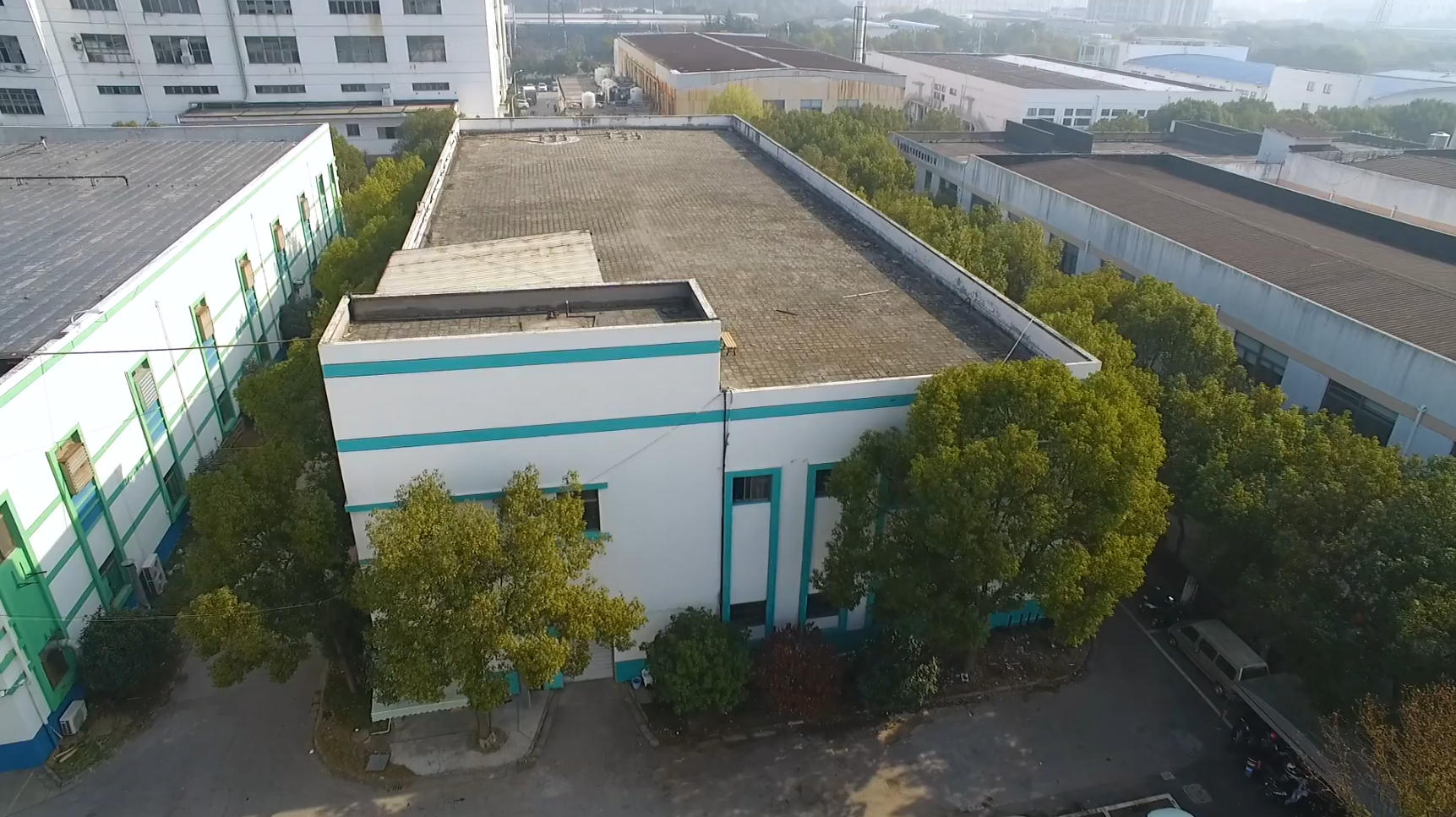
Paifeite Automation has manufactured automated integration equipment in Suzhou since 2004, with a 1,750 m² facility, annual output of 180 units, and exports to more than 20 countries across the EU, Asia, North America, and South America. For gel pen producers planning a high-volume line, that track record is best tested the same way as the machine itself: by specification, by certificate, and by an acceptance run.
Planning a high-volume gel pen assembly line?
Share your pen type, required monthly output, and available floor space, and the Paifeite Automation team can confirm whether the Model 399A2 configuration fits — including the ODM customization scope, compliance documentation, and lead time. Free onsite training is included with delivery.
Download the brochure: Paifeite Automation product brochure (PDF)
Contact: Tiffany Zhou | Email: zhouyt@szpaifeite.com | Tel / WhatsApp: +86 18550217527 | Website: paifeite-automation.com
Ask about the Model 399A2 gel pen assembly machineHave Questions or Need More Details?
Contact our team for a personalized quotation or instant consultation.
Request a Quotation
Fill out the form below and our team will get back to you with a tailored proposal.
WhatsApp Direct Chat
Prefer to chat in real-time? Message us on WhatsApp for instant assistance & quick answers.
- Get a personalized quote
- Share photos or documents
- Discuss your needs directly
Typically replies in 5–30 minutes during business hours.