
Gel Pen vs Ballpoint Pen Assembly Machines: A Data-Driven Comparison for Buyers
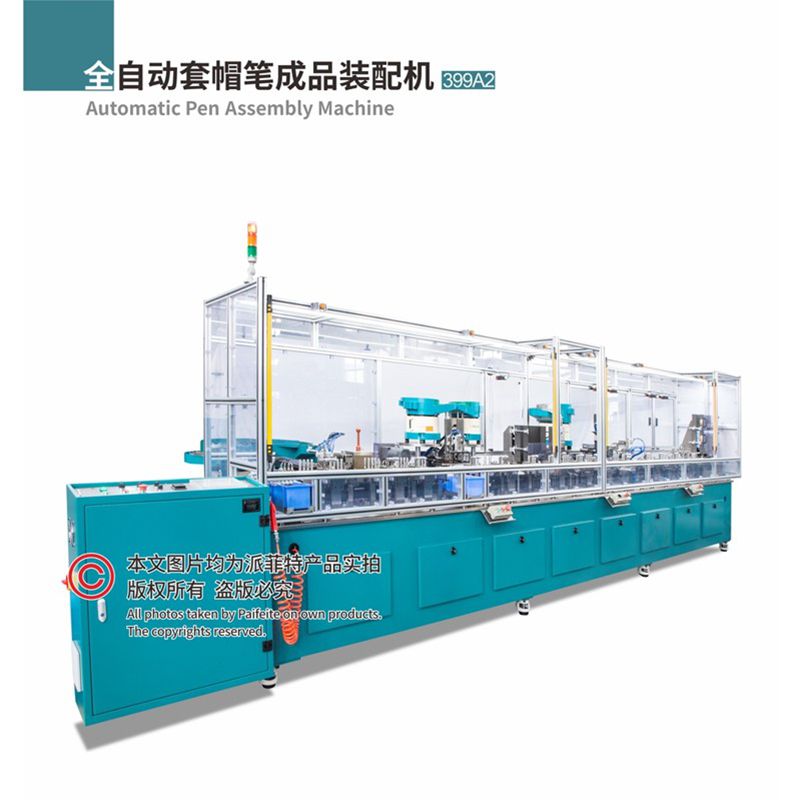
Choosing between a gel pen assembly machine and a ballpoint pen assembly machine is a specification problem before it is a supplier problem. Both machines sit in the same broad category, both are described as automatic chain-carry horizontal platforms, and both are marketed under the same generic term — pen assembly machine. They are not interchangeable by default, because they differ in rated output, physical envelope, assembly-mode wording and construction material.
This comparison places two reference machines from Suzhou Paifeite Automation Technology Co., Ltd. (Paifeite Automation) side by side: the Gel Pen Assembly Machine model 399A2 and the Ballpoint Pen Assembly Machine model 395A1. Every figure below comes from the published specification of those two models. Where a specification is not published, this article says so instead of filling the gap with an estimate or a market rumour.
Short answer. The Gel Pen Assembly Machine 399A2 is rated at 120–130 pieces per minute and is listed with an assembly mode of 4 up, chain carry, horizontal type, two types universal, at overall dimensions of L7000 × W1500 × H2300 mm. The Ballpoint Pen Assembly Machine 395A1 is rated at 120–140 pieces per minute, is listed as suitable for the automatic assembly of ballpoint pens and gel pens, and measures L4800 × W1700 × H2000 mm. Buyers whose output is gel-pen-led, or who need a platform explicitly described as two-types universal, should start with the 399A2. Buyers who want the higher rated ceiling in the more compact frame, or who run ballpoint and gel pens on one line, should start with the 395A1.
Why the Gel-vs-Ballpoint Question Is Usually Asked Too Late
The two machines share a category label, and that label hides the three variables that actually decide whether a purchase works in a real factory.
- Format universality. A platform described around gel pen production and a platform described as suitable for both ballpoint pens and gel pens are not the same asset, even when their speed ranges overlap.
- Rated output. The published ranges differ: 120–130 pieces per minute for the 399A2 and 120–140 pieces per minute for the 395A1. The lower bounds are identical, so the difference sits entirely at the top of the range.
- Physical envelope. Length, width and height differ across the two models by more than a metre in one dimension. That directly affects bay layout, aisle planning and ceiling clearance.
Many first-time buyers resolve the question by comparing quotations instead of specifications. The risk in that approach is straightforward: the lowest quotation may belong to the machine whose 7000 mm frame does not fit the available bay, or whose height exceeds the clearance under the ceiling services. The workable sequence is to define the pen format first, then the required output, then the envelope — and only then discuss commercial terms.
A second, more common failure is category confusion. Stationery gel pens and ballpoint pens are assembled on platforms such as the 399A2 and the 395A1. Insulin pens and medical injection pens belong to a different machine family — for example the Insulin Pen Assembly Machine model 363A, which is an automatic assembly system designed for the medical device industry and constructed with medical-grade 304 stainless steel, aluminum profile, engineering nylon and painted carbon steel. Treating stationery pen assembly and medical pen assembly as one procurement category produces specification mismatches that no price negotiation can repair. This comparison therefore stays strictly inside the stationery category.
What the Pen Assembly Equipment Market Looks Like in 2026
The demand background explains why buyers are now comparing these two models directly rather than choosing by habit.
The global automated assembly machine market was valued at USD 2,624.73 million in 2023 and is projected to reach USD 4,098.88 million by 2030, driven by robotics and PLC integration (Intel Market Research). Pen assembly sits inside that broader shift from manual and semi-automatic benches to PLC-controlled, chain-carry platforms.
On the consumption side, China's total pen exports reached USD 2.65 billion in 2024, of which ballpoint pens accounted for USD 1.121 billion (Observatory of Economic Complexity). That volume supports a mature supply chain for pen assembly machinery, and it also means most buyers evaluating a gel pen assembly machine or a ballpoint pen assembly machine are competing on cost per unit rather than debating whether to automate at all.
A third signal comes from the adjacent medical segment. The global injection pen market reached USD 47.0 billion in 2024 and is growing at a CAGR of 7.9% through 2030 (MarketsandMarkets), with disposable pen injectors holding an 87.9% market share in 2025 (Fortune Business Insights). Assembly systems serving that segment are governed by a different standard family — the ISO 11608 series, including ISO 11608-1:2022, which defines primary design and verification requirements for needle-based injection systems. That separation is another reason the gel-vs-ballpoint decision should be settled inside the stationery category first.
The Two Reference Machines, Spec by Spec
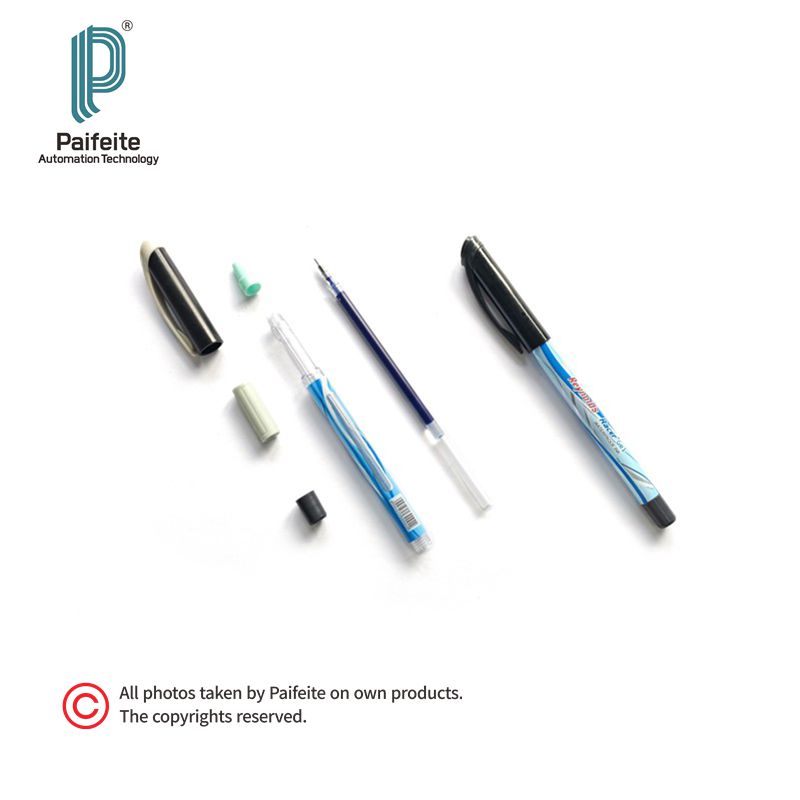
Gel Pen Assembly Machine, model 399A2
- Rated capacity: 120–130 pieces per minute
- Assembly mode: 4 up, chain carry, horizontal type, two types universal
- Overall dimensions: L7000 × W1500 × H2300 mm
- Construction material: 45# steel / 6061 aluminum / stainless steel
- Listed application industries: stationery manufacturing industry, pen making industry, office supplies production industry
What the numbers mean for a layout decision: the 399A2 is the longer and taller of the two machines. Its 7000 mm × 1500 mm envelope works out to roughly 10.5 m² of floor footprint, calculated directly from the listed dimensions. Its 2300 mm height is the tallest figure in this comparison and should be checked first against ceiling height, ductwork, cable trays and lighting in the intended bay.
The most commercially significant item on the sheet is the phrase embedded in the assembly mode. The 399A2 is listed as two types universal alongside a 4-up, chain-carry, horizontal configuration. That wording indicates a platform specified to handle two pen types. Buyers should confirm with the supplier exactly which two types, and how the switch between them is executed — tooling swap, parameter change, or both — because the changeover method determines real-world line availability far more than the rated speed does.
The material list — 45# steel, 6061 aluminum and stainless steel — describes a mixed-metals construction. For a stationery production environment, that combination is relevant mainly to stiffness under continuous chain-carry operation and to long-term wear on locating and guide surfaces. It is not a statement about cleaning regimes or cleanroom classification, and buyers who need those properties should request them separately.
Ballpoint Pen Assembly Machine, model 395A1
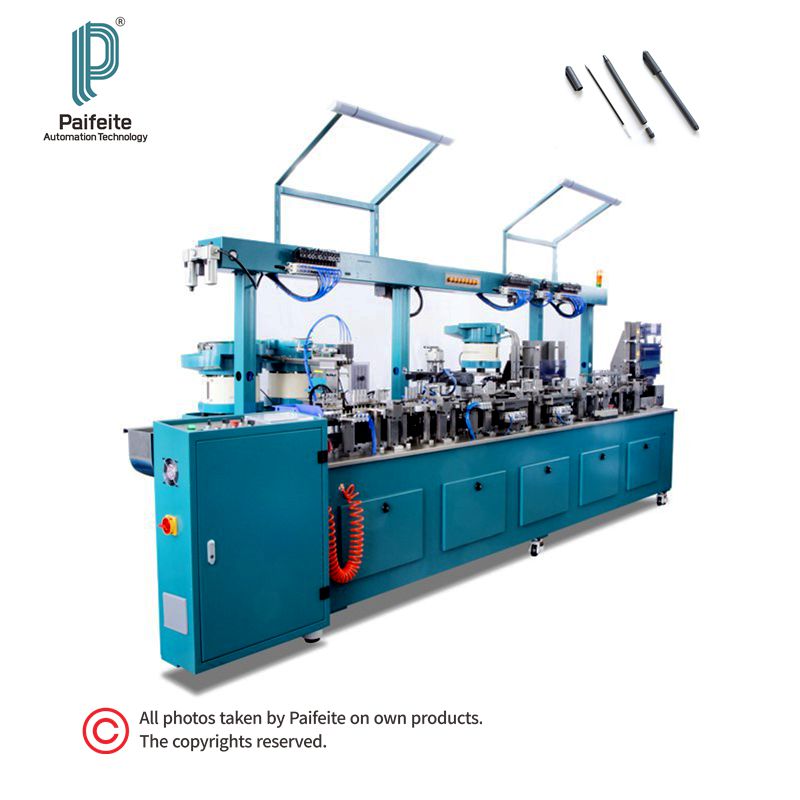
- Rated capacity: 120–140 pieces per minute
- Assembly mode: 4 up, chain carry, horizontal type
- Overall dimensions: L4800 × W1700 × H2000 mm
- Construction material: aluminum profile, 304 stainless steel, engineering nylon, painted carbon steel
- Listed application: stationery industry — suitable for the automatic assembly of ballpoint pens and gel pens
The 395A1 is the shorter, wider and lower machine. Its 4800 mm × 1700 mm envelope is approximately 8.16 m², again calculated from the listed dimensions — about 2.34 m² smaller than the 399A2 footprint. Its 2000 mm height is 300 mm lower than the 399A2, which matters in plants with low ceiling clearance or dense overhead services. It is 2200 mm shorter in length but 200 mm wider, so it does not automatically fit every bay the 399A2 fits; it suits a bay with a different aspect ratio.
The most important line on this sheet is the application statement: the 395A1 is suitable for the automatic assembly of ballpoint pens and gel pens. That makes it a dual-format platform rather than a ballpoint-only machine, which is decisive for plants whose order book mixes both formats and who do not want to dedicate separate equipment to each.
On speed, both machines share a 120 pieces-per-minute lower bound. The difference appears only at the top: 140 versus 130 pieces per minute. If both platforms run at the top of their listed ranges, the arithmetic gives the 395A1 a 10-piece-per-minute advantage — approximately 600 additional pieces per hour at those stated ratings. Whether that gap survives on a real shop floor depends on uptime, changeover frequency and downstream packing capacity, none of which appear in the published specification sheets.
Step-by-Step: How to Decide Between the Two Models
- Fix the primary pen format. Decide whether the line is gel-pen-led, ballpoint-led, or genuinely mixed. A gel-led programme points toward the 399A2. A ballpoint-led or mixed programme points toward the 395A1, which is listed for both ballpoint pens and gel pens.
- Convert demand into a per-minute requirement. Divide the shift target by available running minutes to get a required pieces-per-minute figure. A machine rated at 120–130 or 120–140 pieces per minute defines the ceiling of that calculation, not a guaranteed net output. If the required net figure sits close to the lower bound of the rated range, ask the supplier how the gap between rated and net output is normally bridged.
- Measure the envelope, including height. Compare your bay against L7000 × W1500 × H2300 mm for the 399A2 and L4800 × W1700 × H2000 mm for the 395A1. Height is the variable most often forgotten: 2300 mm of machine height leaves materially less room under ceiling services than 2000 mm.
- Check construction against your production environment. The 399A2 uses 45# steel, 6061 aluminum and stainless steel. The 395A1 uses aluminum profile, 304 stainless steel, engineering nylon and painted carbon steel. Neither list is a cleanliness certification, so plants with specific dust or contamination requirements should raise those requirements explicitly rather than inferring them from the material line.
- Map the surrounding line and interfaces. Both machines sit inside a wider stationery automation set that can include an automatic feeding machine, pen cap assembly machine, ink filling machine, printing machine, labeling machine, packaging machine, conveyor belt and a counting and packing system. Confirm which of these you are buying now and which are planned later, so the main frame is specified with the right interfaces from the start.
- Validate before committing to a production order. Specification sheets settle feasibility, not fit. Ask for a configuration review against your actual pen components and, where a trial run is possible, use it to confirm assembly behaviour before the purchase order is issued.
Where Each Machine Fits: Practical Use Cases
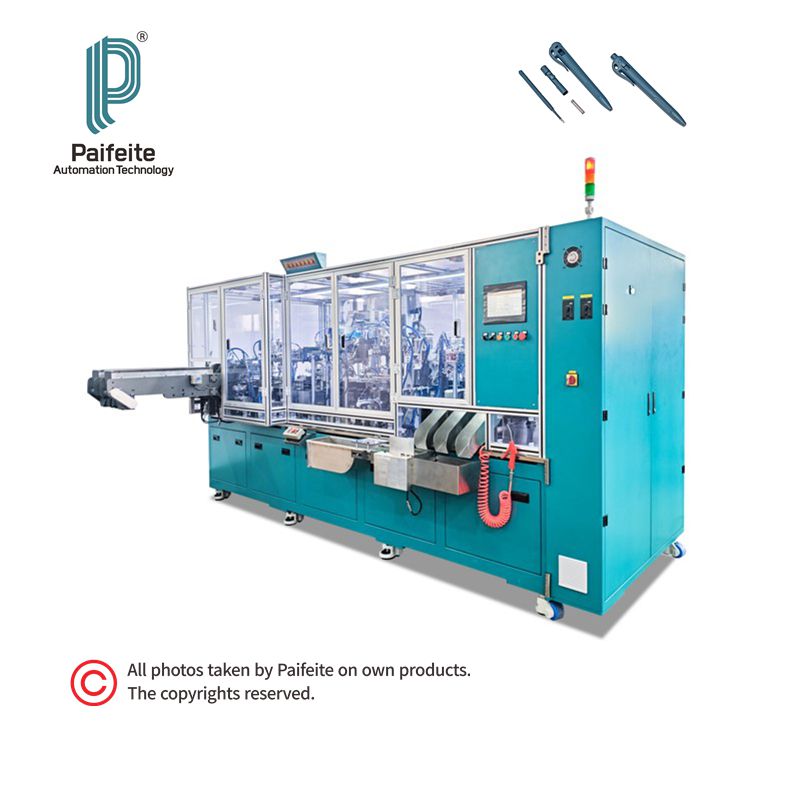
1. Dedicated gel pen production at steady volume. A plant running gel pens as its dominant format and needing a platform explicitly described as handling two pen types lands on the 399A2. The 120–130 pieces-per-minute rating and the two-types-universal assembly mode fit a schedule that mixes two gel pen models on the same week.
2. Ballpoint-first production with gel spillover. A plant whose mainstay is ballpoint pens but which accepts gel pen orders fits the 395A1, since it is listed as suitable for the automatic assembly of both. The 120–140 pieces-per-minute ceiling and the lower 2000 mm frame also suit established buildings where overhead clearance is constrained.
3. Mixed-format job shops and OEM or gift pen programmes. Where the mix shifts month to month, the deciding factor is changeover, not top speed. Buyers in this segment should compare the 399A2 and 395A1 on how each handles a format switch, and should treat the published speed ranges as secondary.
4. Component and refill supply behind the main line. Pen assembly rarely stands alone. Where a plant also produces refills, the Pen Refill Assembly Machine model 372A is rated at 120–140 pieces per minute and is designed for the automatic assembly of various pen refills, which keeps the upstream supply aligned with either main platform.
5. Multi-format writing instruments beyond gel and ballpoint. Where a plant also builds fountain pens or runs high-variety stationery work, the Non-standard Pen Assembly Machine model 415A is listed for the mass production and automatic assembly of gel pens, ballpoint pens and fountain pens at 120–140 pieces per minute, with a 4-up, chain-carry, horizontal assembly mode. It sits upstream of this two-model comparison rather than replacing either machine.
6. Medical pen formats. Insulin pens and disposable pen injectors are outside this comparison entirely. The Insulin Pen Assembly Machine model 363A serves the medical device industry at 50–60 pieces per minute with a two-outputs-per-time, chain-carry configuration, and medical assembly requirements are governed by a separate standard family.
Side-by-Side Comparison Table
| Decision parameter | Gel Pen Assembly Machine 399A2 | Ballpoint Pen Assembly Machine 395A1 |
|---|---|---|
| Rated capacity | 120–130 pieces per minute | 120–140 pieces per minute |
| Assembly mode | 4 up, chain carry, horizontal type, two types universal | 4 up, chain carry, horizontal type |
| Overall dimensions (L × W × H) | L7000 × W1500 × H2300 mm | L4800 × W1700 × H2000 mm |
| Floor footprint (calculated from listed dimensions) | Approx. 10.5 m² | Approx. 8.16 m² |
| Machine height to plan for | 2300 mm | 2000 mm |
| Construction material | 45# steel / 6061 aluminum / stainless steel | Aluminum profile, 304 stainless steel, engineering nylon, painted carbon steel |
| Listed pen formats and industries | Gel pen platform; stationery manufacturing, pen making, office supplies production | Ballpoint pens and gel pens; stationery industry |
| Best-fit buyer profile | Gel-led output; explicit two-type requirement; more floor length available | Ballpoint-led or mixed ballpoint-plus-gel output; tighter bay; higher rated ceiling required |
Two figures in the table are derived rather than published: the footprint values are the products of the listed length and width, and the height row restates the listed machine height. All other values are taken directly from the published specifications of the two models.
What the Published Specifications Do Not Tell You
A fair comparison has to state its own boundaries. Neither specification sheet publishes the following, and buyers should request them from the supplier before quotations are compared on price:
- Changeover time between the two pen types on the 399A2, and the tooling required
- Installed power, compressed air demand, and utility connection points
- Net output after rejects, micro-stops and changeover, as distinct from rated output
- Dimensions of feeding, printing, labeling and packing modules that sit alongside the main frame
- Certification scope or conformity documentation for a specific destination market
Quoting two machines at the same throughput without these five items produces a comparison that looks complete and is not.
About the Manufacturer Behind Both Models
Suzhou Paifeite Automation Technology Co., Ltd. is a non-standard automated integration equipment manufacturer based in Suzhou, China, founded in 2004 and specialising in the research, development, production and sales of automated integration equipment. Its main product is the pen assembly machine, and its equipment set covers ball pen assembly machines, refill assembly machines, refill testing machines, pen packing machines and several categories of printing machine.
The company operates from a 1750 m² manufacturing facility with approximately 48 employees, including an R&D team of 10 engineers, and reports an annual production capacity of about 180 units. Export business accounts for 70% of total sales, with main markets in the EU, Asia, North America and South America, and equipment delivered to customers in more than 20 countries.
FAQ: Gel Pen vs Ballpoint Pen Assembly Machines
What is the difference between a gel pen assembly machine and a ballpoint pen assembly machine?
The difference is visible in three published parameters, not in the category name. The Gel Pen Assembly Machine model 399A2 is rated at 120–130 pieces per minute and measures L7000 × W1500 × H2300 mm. The Ballpoint Pen Assembly Machine model 395A1 is rated at 120–140 pieces per minute and measures L4800 × W1700 × H2000 mm. The 399A2 also lists a "two types universal" assembly mode, while the 395A1 is listed as suitable for the automatic assembly of both ballpoint pens and gel pens. In short, the two models differ in speed ceiling, footprint and stated format coverage rather than in fundamental machine category.
Can one pen assembly machine run both gel pens and ballpoint pens?
Yes, according to the published specifications. The Ballpoint Pen Assembly Machine model 395A1 is listed for the automatic assembly of ballpoint pens and gel pens in the stationery industry, so it is specified as a dual-format platform. The Gel Pen Assembly Machine model 399A2 lists an assembly mode of 4 up, chain carry, horizontal type, two types universal, which also indicates a platform specified for two pen types. In both cases, buyers should confirm with the supplier which specific pen types are covered and how the format switch is executed, because published specifications state coverage but not changeover time.
How much floor space does each machine require?
Based on the published overall dimensions, the Gel Pen Assembly Machine model 399A2 occupies roughly 10.5 m² of floor area at L7000 × W1500 mm, with a machine height of 2300 mm. The Ballpoint Pen Assembly Machine model 395A1 occupies roughly 8.16 m² at L4800 × W1700 mm, with a machine height of 2000 mm. Those footprint figures are calculated from the listed dimensions and cover the machine itself; space for feeding, printing, labeling and packing modules, plus operator access and service clearance, must be added separately during layout planning.
Which model should a first-time buyer choose?
The decision rule follows the product mix first. If gel pens are the dominant format and the plant needs a platform explicitly described as two types universal, the 399A2 at 120–130 pieces per minute is the closer match. If ballpoint pens are dominant, or the order book mixes ballpoint and gel pens on the same line, the 395A1 at 120–140 pieces per minute is the closer match, and it also requires less floor area and less height clearance. Where the product mix is genuinely balanced and changes frequently, the deciding factor should be changeover performance, which is not published and must be requested from the supplier.
Can a buyer validate a machine before placing a production order?
Validation is the recommended final step of the selection process rather than an optional one. Because neither the 399A2 nor the 395A1 specification sheet publishes changeover time, utility demand or net output, the only reliable way to close those gaps is a direct technical review against your actual pen components, followed by a trial run where one is possible. Buyers can send their pen format, target output and bay dimensions to Paifeite Automation through paifeite-automation.com or by email at zhouyt@szpaifeite.com, and can review the full equipment range in the downloadable product brochure before requesting a quotation. WhatsApp contact is also available on +86 18550217527.
Conclusion: Match the Platform to the Format, Not the Price Tag
The gel-versus-ballpoint decision does not have a single correct answer, and any article claiming one should be treated with caution. What the published specifications do support is a clear split. The Gel Pen Assembly Machine model 399A2 covers 120–130 pieces per minute, uses a 4-up chain-carry horizontal assembly mode listed as two types universal, measures L7000 × W1500 × H2300 mm, and is constructed from 45# steel, 6061 aluminum and stainless steel. The Ballpoint Pen Assembly Machine model 395A1 covers 120–140 pieces per minute, uses a 4-up chain-carry horizontal assembly mode, is listed as suitable for both ballpoint pens and gel pens, measures L4800 × W1700 × H2000 mm, and is constructed from aluminum profile, 304 stainless steel, engineering nylon and painted carbon steel.
The practical rule that follows is simple: define the format, size the output, measure the bay including its height, then confirm the utility and interface requirements that the specification sheets leave open. A machine selected in that order will fit the production plan it was bought for. A machine selected on price alone may not fit at all.
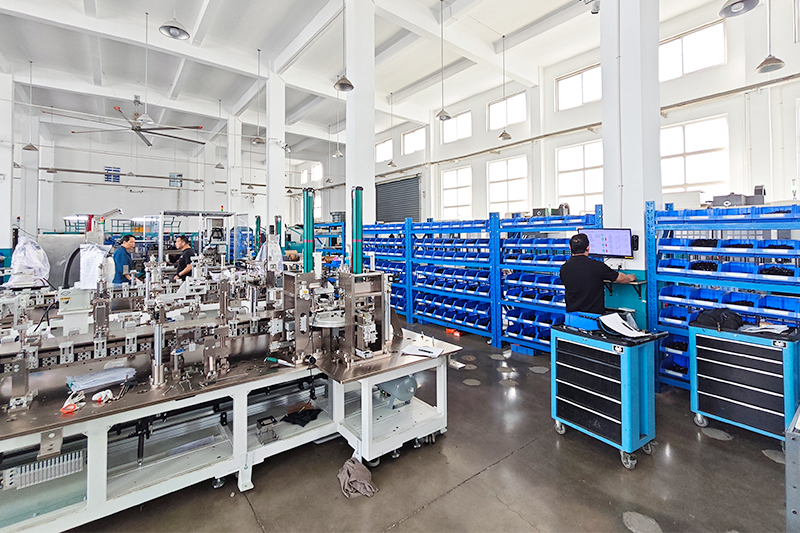
Next step. If you are comparing the 399A2 and 395A1 for a specific pen programme, send your pen format, target output and available bay dimensions to the Paifeite Automation team. The team can confirm which listed configuration matches your requirement and which utility and changeover details you still need before a quotation is meaningful.
Email: zhouyt@szpaifeite.com · WhatsApp: +86 18550217527 · Website: www.paifeite-automation.com · Download the product brochure (PDF)
Suzhou Paifeite Automation Technology Co., Ltd. — Building 3, No.25 Tangxi Road, Huqiu District, Suzhou City, Jiangsu Province, China.
Have Questions or Need More Details?
Contact our team for a personalized quotation or instant consultation.
Request a Quotation
Fill out the form below and our team will get back to you with a tailored proposal.
WhatsApp Direct Chat
Prefer to chat in real-time? Message us on WhatsApp for instant assistance & quick answers.
- Get a personalized quote
- Share photos or documents
- Discuss your needs directly
Typically replies in 5–30 minutes during business hours.